
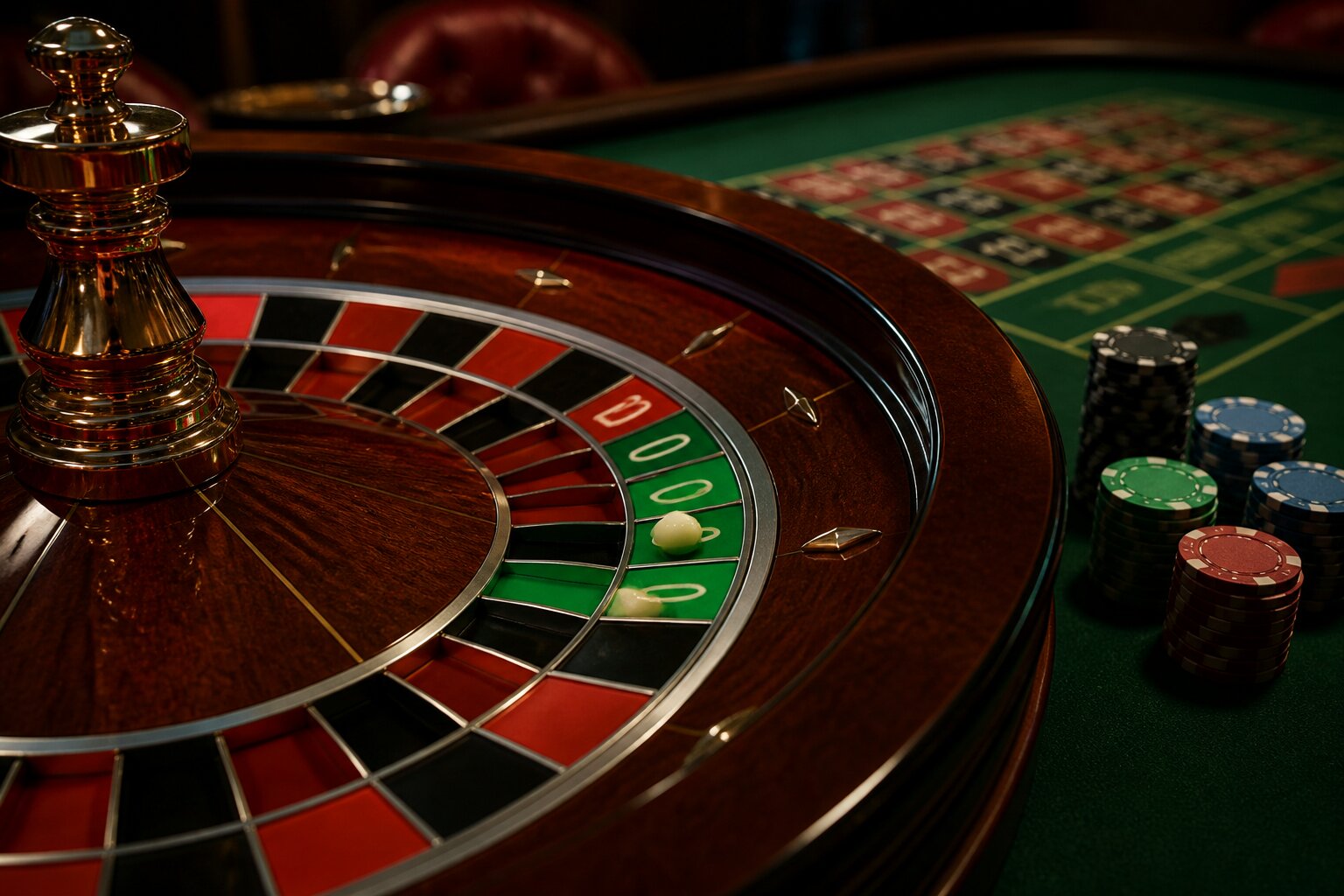
Ever wondered what makes the green pockets on a roulette wheel so special? Those green zeros change how bets pay out and how the house edge is calculated, so understanding them gives a clearer sense of what happens each spin.
Many players focus on red and black, but the green pockets are handled differently and can alter the outcome of outside bets. Read on to learn how zero and double zero work, what payouts they offer, and how the two main wheel types compare.
Understanding Roulette: The Basics of the Wheel and Table
Roulette is played with a spinning wheel and a matching table layout. The wheel contains the numbers 1 to 36, split between red and black, and at least one green pocket: the single zero on European wheels and both zero and double zero on American wheels. The table shows all these numbers plus boxes for outside bets such as red/black, odd/even and high/low.
When you place chips on the table, you choose either individual numbers or broader categories. The green pockets are not part of the red/black or odd/even groups, so when the ball lands there those outside bets usually fail. That separation is what creates the house edge: an extra pocket that the simple even-money bets do not cover. This difference between the green pockets and the rest of the numbers is central to understanding payout calculations and how the wheel type affects odds. Ahead you will see precisely how those specific green bets are made and what they return when they win.
What Do Zero and Double Zero Mean in Roulette?
The terms zero and double zero refer to the green pockets that sit apart from the numbered red and black sections. European roulette has one green slot labelled 0. American roulette adds a second green slot labelled 00. Both are deliberately set apart on the wheel and on the table layout to show that they are not part of the usual even-money or colour bets.
Each green pocket has its own betting box on the table, making it possible to place direct bets on them. Their presence alters the chances for every wager because they add outcomes that are not covered by most common bets. Next, we’ll look at how you can place bets on these pockets and the different ways they can be covered on the layout.
Zero and Double Zero Bets: How They Work
Players can place a straight-up bet by putting a chip directly on the green box marked 0 or 00; this covers just that single pocket. Other options let a wager cover more than one number: a split bet sits on the line between two adjacent numbers (for example, 0 and 1), while a trio or street-style bet includes three numbers that meet at a corner on the layout (such as 0, 1 and 2). On American tables there is also a top-line option that covers 0, 00, 1, 2 and 3.
Because the green pockets are separate from the red/black and odd/even groupings, these outside bets generally lose when the ball lands on zero or double zero, unless the table offers a specific rule that changes that outcome. Certain tables may apply special rules that alter what happens to outside bets when zero appears; these rules vary by game and should be checked before play. After you know the ways bets can be placed, the next section explains the precise payouts you can expect when those green bets win.
How Much Do Green Zero Bets Pay Out?
A straight-up bet on either zero or double zero pays 35 to 1. So, a £1 straight-up on 0 that wins returns £35 in winnings plus the original £1 stake, totalling £36. The same payout figure applies whether the winning pocket is 0 or 00.
Split bets that include a green pocket pay 17 to 1, so a £1 split returns £17 plus the stake if either number hits. Trio or street bets that include the zero pay 11 to 1, giving £11 plus the stake on a £1 wager. On American wheels, the special top-line bet covering 0, 00, 1, 2 and 3 pays 6 to 1.
These payout figures are standard across roulette games; what changes between wheels is the underlying chance of a win, because American wheels have an extra green pocket. With payouts explained, the next section compares the two wheel types and shows how that additional pocket affects the house edge and return to player.
Comparing European vs American Roulette Wheels
The essential difference between the two main roulette types is pockets: European wheels have 37 pockets with a single zero, while American wheels have 38 pockets with a zero and a double zero. That extra pocket makes the American version less favourable from a mathematical perspective because it increases the house advantage across all bets.
European roulette therefore offers a smaller house edge overall, though both variants use the same payout schedule for winning numbers. The addition of the double zero on American wheels is why many players prefer the single-zero format when they want the better theoretical return. To make that comparison clearer, the following short subsections show the relevant odds and return percentages for each wheel type.
Zero Bet Odds and RTP in European Roulette
European roulette has 37 pockets in total. A straight-up bet on zero has a 1 in 37 chance of success, which equates to a probability of 2.70%. The standard payout for a straight-up win is 35 to 1, but because the chance of winning is 1/37 rather than 1/36 the casino retains a house edge of 2.70%, giving an expected return to player (RTP) of 97.30%.
This gap between payout and true odds is the simple reason the house retains its advantage; the next subsection shows how adding a second green pocket changes those figures.
Double Zero Bet Odds and RTP in American Roulette
American roulette has 38 pockets. Each green number—zero or double zero—has a 1 in 38 chance of being the winning pocket, about 2.63% per green slot. The larger total of possible outcomes reduces the overall RTP to roughly 94.74%, so the house edge increases to about 5.26%.
That difference in RTP and house edge is the principal practical effect of the double zero: the same payouts apply, but the win probabilities are lower. With those mechanics in mind, the next section considers why green bets are treated differently on the table and how that affects play.
Why Are Green Number Bets Considered Unique?
Green number bets are unique because they are visually and functionally separate from all other numbers, and because their occurrence causes most outside bets to lose. Their position and colour underline that they are exceptions to the usual red/black and odd/even groupings, so when a green pocket appears it interrupts many common wagering options.
A straight-up win on a green pocket brings one of the game’s larger payouts, but those wins are correspondingly less frequent because of the limited number of green slots. Their special status also gives them strategic value for players who favour single-number wagers, as the payoff for a direct hit is high relative to the stake. Understanding that balance between payout and probability clarifies why players treat green bets differently, and leads into the final discussion about whether any approach can improve one’s chances.
Can You Improve Your Chances with Zero or Double Zero Bets?
The chance of a green pocket winning is fixed by the wheel’s design: 1 in 37 for a single zero and 1 in 38 for each green slot on a double-zero wheel. Those probabilities do not change with previous spins or with any pattern of betting, so no system or routine can alter the fundamental odds.
Because every spin is independent and the payout structure is fixed, the decision to bet on zero or double zero is a matter of preference and risk appetite rather than a way to increase success. The mathematical edge remains with the house by design, so sensible play focuses on managing stakes and expectations. If gambling causes concern, seek help through recognised support services and set clear personal limits before playing.
Play with awareness of the rules and payouts described here, and you’ll have a clear picture of what green pockets mean for your roulette experience.
Enjoy Casino Games at UK Online Slots
We’re always happy to welcome new players who want to enjoy casino games in a relaxed, friendly setting. Take things at your own pace and discover what our site has to offer.
**The information provided in this blog is intended for educational purposes and should not be construed as betting advice or a guarantee of success. Always gamble responsibly.