
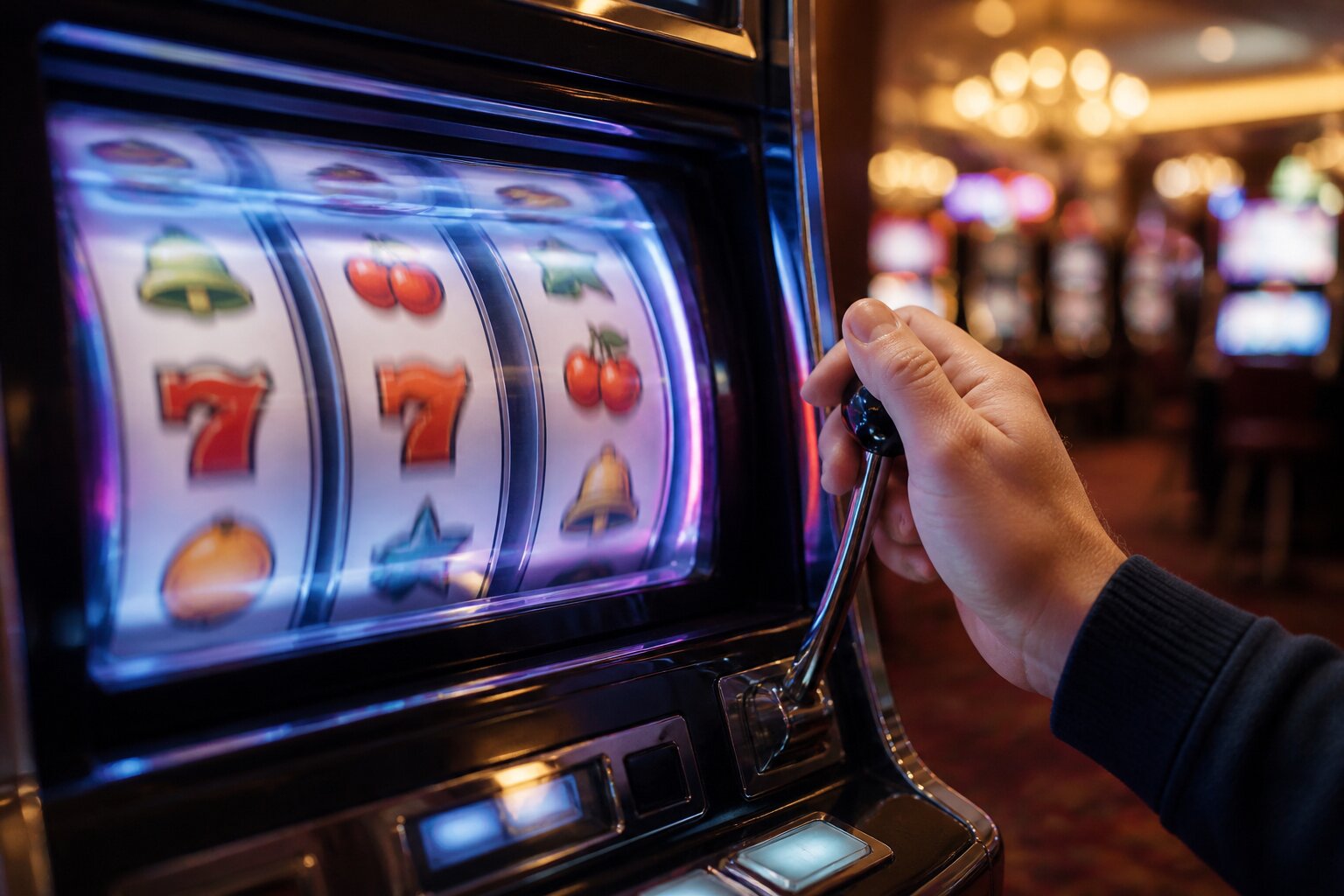
Ever felt the rush as reels whirl and symbols slow, making your heart skip a beat? The lights and sounds are designed to heighten that moment, but behind the spectacle there’s a tightly controlled system deciding every result.
Many players look for patterns or routines to gain an edge, yet the reality is that modern slot design and regulation prevent previous spins from affecting future ones. Understanding how outcomes are generated helps keep play clearer and more enjoyable, and it also explains why strategies based on patterns won’t change results.
Below we unpack what happens when you press spin, how the machines determine wins, and how to interpret a real example so the mechanics make sense.
How Do Slot Machines Work?
Slot machines are built to be simple to use but technically precise beneath the surface. Pressing spin doesn’t start a mechanical countdown so much as it signals a programme to finalise a result determined instantaneously by the machine’s core system.
That core is the Random Number Generator (RNG), a piece of software that runs continuously and produces sequences of numbers. When a player initiates a spin, the RNG selects values that map to positions on each reel; those positions then display the symbols you see. Because the RNG is always operating and can generate thousands of values per second, the exact result ties to the precise moment the game is played.
Regulation and independent testing ensure operators and developers cannot alter results on the fly. In other words, the outcome is fixed at the instant the spin is registered, and no subsequent action can modify it. This technical setup preserves fairness for every player, whether at a physical machine or online. Next, we’ll look more closely at the RNG and why it matters for fairness.
The Role of Random Number Generators in Slot Outcomes
The RNG guarantees that outcomes are unpredictable and not influenced by prior spins. It continually cycles through values so that, the moment a spin is triggered, the game software reads the current numbers and converts them into reel positions and symbols.
Because the RNG operates so quickly, two players pressing spin at the same time in different places will still receive independent results. Independent auditors and regulatory bodies test RNG implementations to confirm they meet statistical standards for randomness and impartiality. Those checks prevent tampering and help ensure the maths behind payouts behaves as intended over large samples.
Understanding the RNG also explains why attempting to time or sequence spins has no effect: there is no hidden state a player can access or alter once the spin begins. With that technical footing in place, it helps to know how symbols and paylines use those RNG results to produce a win or no win.
Understanding Paylines and Symbols
Paylines are the patterns across the reels that determine whether matching symbols create a winning combination. Classic games might use a single horizontal line; modern designs can feature many patterns that pay in various ways, such as diagonal or zigzag routes across the reels.
Symbols are the visual elements that occupy reel positions. Standard examples include simple icons used in traditional games, alongside themed graphics in contemporary titles. Special symbols—most commonly Wilds and Scatters—change how combinations are formed or unlock additional features such as free spins or bonus rounds.
Each slot’s paytable explains which symbols pay and along which paylines. That paytable also shows how much each combination is worth, so players can see what a match will deliver before they play. Knowing where to look in the paytable makes it straightforward to interpret the result of a spin, which leads naturally into a concrete example of reading a spin result.
What Determines a Winning Spin?
A winning spin is the intersection of the RNG’s result and the slot’s predefined rules. Once the RNG assigns symbols to reel positions, the game checks those positions against active paylines and the paytable. If a pattern matches one of the paytable’s winning combinations, the software calculates and awards the payout.
Two important design elements influence how often wins occur and how large they can be: symbol weighting and Return to Player (RTP). Symbol weighting means symbols do not all have an equal chance of appearing; lower-paying symbols tend to appear more often than top-paying ones. RTP is a long-run statistical metric expressed as a percentage, indicating the fraction of stakes a slot returns on average over a very large number of spins. For example, an RTP of 95% implies that, across millions of spins, the slot returns about £95 for every £100 staked in aggregate, but it does not predict what will happen in any individual session.
With the mechanics and metrics explained, the next section walks through a concrete spin so you can see those concepts in action.
How to Read Slot Results: Example Spin Explained
Reading a spin’s outcome becomes clear when the paytable, paylines and special symbols are known. Consider a typical 5-reel online slot with 10 paylines and common special symbols such as a Wild that substitutes for other symbols.
Imagine staking £1 and the reels stop with the following centre-row (payline 3) sequence:
Reel 1: Cherry
Reel 2: Wild
Reel 3: Cherry
Reel 4: Cherry
Reel 5: 7
The process that follows is automatic. The game recognises that the Wild can substitute for a Cherry, so the centre payline effectively shows four Cherries. Referring to the paytable reveals the payout for four Cherries on one active payline—say, £5 in this example—and the game credits that amount. Visual cues on-screen will highlight the winning line and show the awarded amount.
If, instead, the centre row showed completely mismatched symbols with no qualifying pattern, the game would find no win and typically give a subtle visual indication of that result. Either way, the final outcome is resolved by the slot’s rules once the RNG has mapped numbers to symbols.
Now that the mechanics and interpretation are clear, it helps to separate common misconceptions from how the system actually works.
Common Slot Myths vs the Facts
Players often rely on stories about machines “running hot” or being tweakable, but these notions don’t match how regulated slots operate. Below are a set of common beliefs contrasted with what the technology and regulation actually show.
-
Myth: “The longer a machine hasn’t paid out, the more likely it is to win soon.”
Fact: Each spin is independent; past results do not influence future ones. -
Myth: “Operators can make machines looser or tighter at will.”
Fact: Changes to payout behaviour are controlled and subject to regulatory oversight and testing, not unilateral adjustment. -
Myth: “There’s a timing trick or secret skill to hitting a jackpot.”
Fact: No player action after initiating a spin changes the RNG-determined outcome. -
Myth: “Observed streaks indicate a machine is due or unlikely to pay.”
Fact: Sequences of wins or losses are inherent to random distributions and do not imply a machine has memory.
Are Slot Machines Rigged?
Legitimate, regulated slot machines must meet strict fairness standards and are subject to independent testing to ensure outcomes conform to required statistical properties. These protections are in place to give players confidence that results are generated according to the published rules and metrics.
Can You Predict Slot Outcomes?
Predicting individual spin outcomes is not possible. The architecture of modern slots—continuous RNGs, symbol weighting and enforced paytables—means there is no reliable signal or pattern that can be used to forecast the next result.
Occasional reminders to keep play controlled and informed are important: treat slot games as entertainment, be aware of RTP and variance, and set limits that suit personal circumstances. If play becomes a concern, there are established support options and tools to help manage time and spend.
By understanding the technical and regulatory framework that governs slot outcomes—RNGs, paytables, symbol weighting and RTP—you will have a clearer picture of what to expect from each spin and why many common beliefs about beating slots don’t hold up.
Play Online Slots at UK Online Slots
We invite you to explore the variety of entertainment on offer with us, where there is something for every taste. Enjoy plenty of choice and discover the experience at your own pace.
Getting started is easy: simply create an account, make a deposit and you are all set to play. We look forward to welcoming you to our friendly community.
**The information provided in this blog is intended for educational purposes and should not be construed as betting advice or a guarantee of success. Always gamble responsibly.