
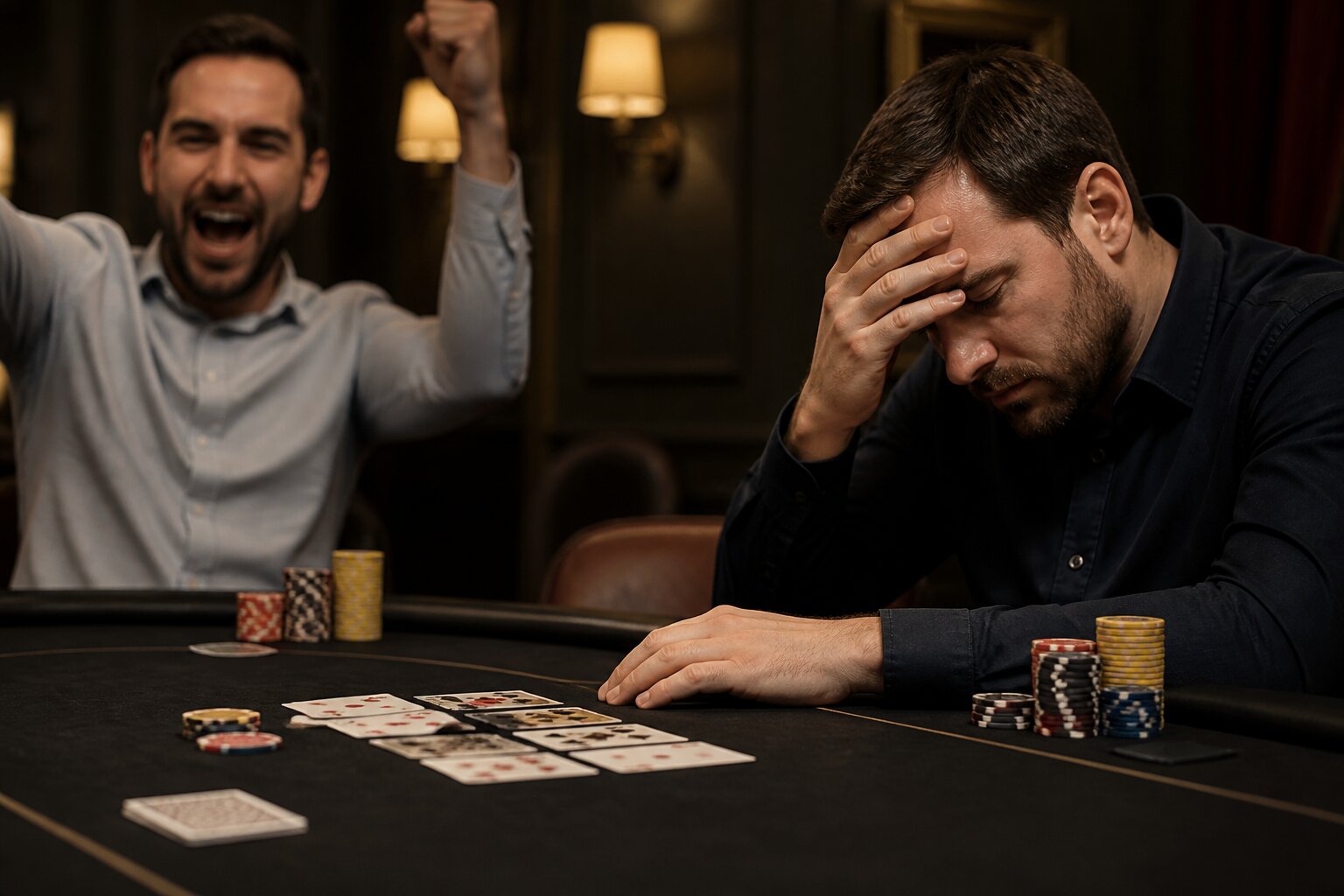
Every poker player has a story about the one that got away — a nearly unbeatable hand that somehow lost in the most astonishing way. If you’ve ever stared at the river and felt the ground shift beneath you, you’ve been on the receiving end of a bad beat.
Bad beats are a dramatic, inevitable part of poker. They can turn a near certainty into a surprising defeat in a single card, and understanding them helps you keep perspective when they happen.
Curious what qualifies as a bad beat, why it happens, and how players tend to respond? This article explains the term in depth, gives clear examples from common game situations, and looks at how the poker community treats these moments.
What Does "Bad Beat" Mean in Poker?
A “bad beat” describes a situation where a hand that was strongly favoured to win ends up losing because an opponent catches an unlikely sequence of cards. The key idea is not simply that a hand loses, but that it loses despite a clear statistical advantage based on the cards visible at the time.
This usually happens late in a hand — on the turn or the river — when the remaining community cards give the trailing player an unexpected completion, such as a straight, flush, or a higher full house. Bad beats can arise in any poker variant where hidden and shared cards interact, so the same phenomenon appears in Texas Hold’em, Omaha and others.
Understanding that a bad beat hinges on probability rather than player intention helps clarify why they are part of the game’s fabric rather than evidence of unfair play.
How Do Bad Beats Happen?
Bad beats arise from the mathematics of card combinations and the information available at each betting round. Players make decisions based on the strength of their hands relative to visible cards and likely holdings of opponents. Sometimes the distribution of unseen cards works against the favourite.
For example, a player holding top pair with a strong kicker may face an opponent on a draw. If that opponent completes a straight or flush on the river, the previously dominant hand is suddenly behind. Likewise, a full house assembled by one player can be eclipsed if an opponent pairs the board in a way that produces a higher full house on the final card.
These outcomes are driven by variance — the natural spread of possible card sequences — and can occur to anyone. Recognising this statistical reality helps players make rational decisions about risk, bet sizing and whether to continue in a hand.
Before we look at concrete examples, bear in mind the scenarios below illustrate how predictable advantage can be overturned late in a hand.
Typical Real-Life Examples of Bad Beats
One classic situation: you hold pocket Aces and play through to the river against an opponent with suited connectors. The community cards leave no immediate threat, but the final card completes a straight or flush for your opponent, and your Aces lose. The upset feels particularly harsh because pocket Aces start as the best possible preflop hand.
Another example involves full houses. You might make three Kings with two Tens on the board and assume you have the winning hand, only to see the river pair the board in a way that gives your opponent a higher full house — perhaps trip Aces over your Kings. The swing is large because full houses are already rare and powerful holdings.
Runner-runner scenarios also create bad beats: when an opponent needs two specific cards in succession to complete a straight or flush and actually hits both. While the odds are long, these sequences happen often enough that every serious player will encounter one.
These examples show how a combination of card distribution and timing can overturn what seemed decisive, which is why strategic thinking must consider not just current strength but the potential for late changes.
Common Scenarios Where Bad Beats Occur
Below are frequent patterns that produce bad beats; each demonstrates how an apparently superior hand can be overtaken by an opponent’s draw completing late in the hand. These are described to clarify the mechanics rather than to provide a checklist for action.
- Overpair vs. underdog draw: Holding an overpair like Kings, you face an opponent with suited connectors. If the opponent completes a straight or flush on the river, the overpair is beaten.
- Full house vs. higher full house: A made full house can be topped when the final card creates a superior full house for an opponent.
- Top set vs. runner-runner: Flopping three of a kind (a set) doesn’t guarantee a win if an opponent hits two precise cards to build a straight or flush.
- Aces cracked: Pocket Aces are dominant preflop, yet they can be defeated when the board allows an opponent to make trips, a straight, or a flush by the river.
Seeing these scenarios play out often sharpens players’ instincts about when to protect a strong holding and when to accept the possibility that variance might deliver an upset.
Is Experiencing a Bad Beat Normal in Poker?
Yes — bad beats are a normal part of poker. Because the game blends hidden information with shared community cards, even statistically superior hands can be overturned. The frequency of bad beats depends on many factors, including the number of opponents and the specific variant being played, but every player encounters them.
Accepting that bad beats occur helps set realistic expectations and supports sound decision-making. Rather than viewing them as personal shortfalls, experienced players treat bad beats as outcomes to be managed within the broader ebb and flow of winnings and losses.
When a bad beat happens, reflecting on the decision process — whether the bet sizes and calls were reasonable given the information at the time — is more productive than dwelling on the single result.
How Do Players React to Bad Beats?
Reactions to bad beats range from mild frustration to humourous storytelling, and how a player responds often reflects their experience. Some players shrug and proceed, treating it as part of the variance; others may take a short break to regain focus before returning to the table.
Emotion-driven choices, such as increasing aggression to chase a perceived injustice, tend to be costly. Players who succeed over time usually maintain composure, stick to their strategy, and review whether their line of play made sense given the cards and betting action.
If emotions run high after a notable loss, stepping away briefly or discussing the hand with peers for perspective are common ways to reset. Support is also available for anyone who finds their reactions to losses becoming disruptive to daily life or decision-making.
Myths About Bad Beats: Separating Fact from Fiction
Several myths surround bad beats, and separating them from fact helps keep expectations realistic.
One persistent myth claims online dealing is manipulated to produce more bad beats. In practice, reputable platforms use tested random number generation and regulatory oversight to ensure fair dealing; individual surprising outcomes reflect statistical variation rather than any design to produce dramatic results.
Another misconception is that skill can fully eliminate bad beats. Skill improves long-term results by guiding better choices on which hands to play, how to size bets, and how to read opponents, but it cannot change the underlying distribution of unseen cards. Every strong player still experiences unlucky-seeming defeats because variance is inherent to the game.
Finally, the idea that bad beats come in personal streaks overlooks the independence of hands: while a player might encounter several surprising losses in a session, each hand is a separate event governed by the same probabilities.
How Are Bad Beats Talked About in Poker Culture?
Bad beats are common fodder in poker conversation, shared both to commiserate and to extract lessons. Players trade “bad beat stories” as a way of acknowledging the shared experience and sometimes lightening the mood after a painful hand.
Those stories are often told with humour or a dry observation about probabilities and timing. Within the social side of poker, the best practice is to be mindful of others’ feelings; some players prefer to move on quickly rather than revisit a recent loss.
Beyond anecdotes, the culture also includes practical responses: comparing lines of play, discussing bet sizing, and considering how the hand might inform future decisions. This blend of storytelling and analysis helps players grow while keeping the experience social and engaging.
Final thoughts: bad beats will happen, but they don’t define a player’s skill. Keeping a clear head, reviewing choices calmly, and maintaining balance at the table are the most reliable ways to respond to them.
If you’d like, I can help tighten any specific section further or adapt the tone to match your site’s voice.
**The information provided in this blog is intended for educational purposes and should not be construed as betting advice or a guarantee of success. Always gamble responsibly.