
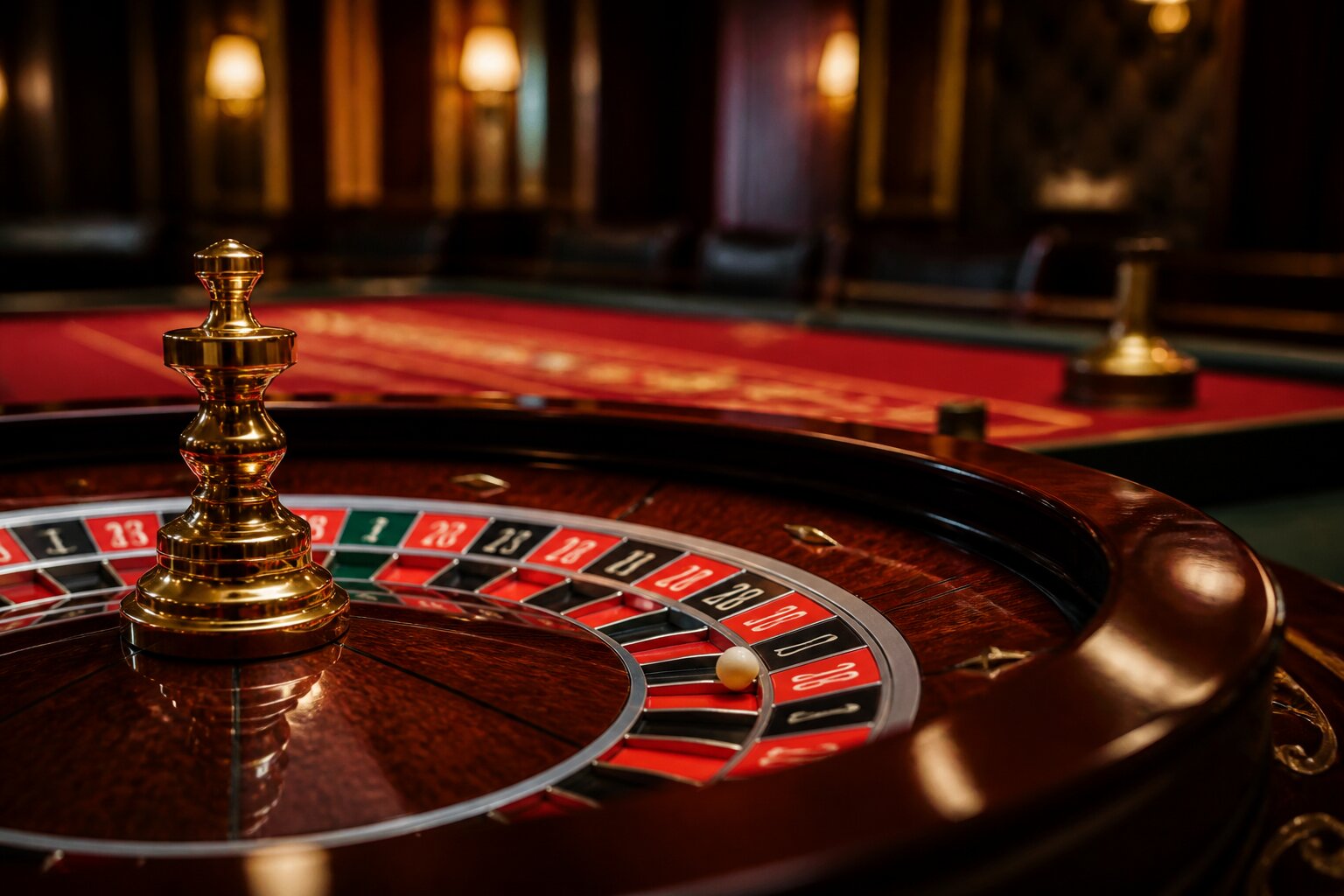
Ever found yourself watching the roulette wheel and wondering how likely it is for red to come up several times in a row? This question has long caught the attention of players because short runs can feel surprising, even when they are simply the product of statistical chance.
Roulette outcomes are governed by the wheel’s layout, so the single-spin probabilities are fixed by the number of red, black and green pockets. Knowing those basics makes it easier to see how streaks emerge and how to interpret them sensibly while playing within limits.
If you want to understand the real maths behind two, three or more reds in succession—and why streaks happen—read on. The next section sets out the basic odds you’ll use throughout the rest of the article.
What Are the Chances of Red Appearing Consecutively in Roulette?
Each spin of a roulette wheel has a fixed probability for landing on red, determined by the wheel’s pockets. In European roulette there are 37 pockets: 18 red, 18 black, and one green zero. That makes the chance of red on a single spin 18/37, or about 48.6%. On American wheels there are 38 pockets (an extra green double zero), so the single-spin chance of red is 18/38, about 47.4%.
To get the probability of red appearing repeatedly, those single-spin figures are multiplied together for each consecutive spin. Using the European single-spin chance as an example:
- Two successive reds: roughly 23.6%
- Three successive reds: roughly 11.5%
- Five successive reds: roughly 2.7%
The same approach applies on American wheels, where the slightly lower single-spin probability produces slightly lower figures for consecutive reds. Next, we’ll look at the straightforward maths behind those numbers so you can see why multiplication is the right tool.
Calculating Roulette Outcomes: Understanding the Maths
Probability of repeated events uses the principle that independent events multiply. Since each spin is independent, the probability of red on spin one and red on spin two is the product of the two single-spin probabilities. Symbolically, if p is the probability of red on a single spin, then the probability of red appearing n times in a row is p^n.
For European roulette p = 18/37, so p^2 gives the chance of two reds, p^3 gives three reds, and so on. For American roulette, substitute p = 18/38 in the same formula. This exponentiation is the only calculation needed to move from a single-spin figure to any length of streak.
As an example of how the numbers fall with modest n: because p is below 50% in both wheel types, probabilities drop quickly as n increases. That mathematical decline explains why long runs happen rarely but are still expected occasionally in extended play.
Why Does Consecutive Red Occur? The Role of Probability
Consecutive reds occur because independent random events sometimes cluster. When many independent trials are performed, short runs and occasional longer runs are an expected feature of the sequence. This is a general behaviour of random processes rather than any change in the wheel’s behaviour between spins.
Streaks can catch attention precisely because they stand out from shorter, mixed sequences. Statistically, runs of three or four of the same colour are common given enough spins, while runs of five or more become progressively less frequent. Seeing a run has no bearing on future spins—the probabilities calculated earlier still apply to whatever comes next.
Understanding that clustering is an inherent property of chance helps set realistic expectations about what patterns mean. With that in mind, the next section examines the kinds of patterns players typically notice and how often they arise in practice.
Common Patterns Seen in Real Roulette Spins
When observing a roulette session, a few kinds of patterns tend to draw notice: short streaks of one colour, alternating colours, and the odd extended run that seems unusually long. All of these are natural outcomes of independent spins and can be explained by the same probability rules discussed earlier.
Players often comment on sequences such as a few reds in a row, a repeated alternation of red and black, or an isolated long run of one colour. Each of these patterns has an associated probability determined by the single-spin chance raised to the appropriate power, and each will appear with some regularity when many spins are observed. For example, runs of three consecutive reds may show up several times in a hundred spins, while five-in-a-row is much rarer but still to be expected across many sessions.
These observations can be interesting and revealing, but they don’t imply any pattern that can be used to predict future results. With that kept in perspective, the next section looks at how the choice of wheel changes the numbers behind those patterns.
Visual Patterns Versus Mathematical Probability
People naturally try to impose a narrative on a string of outcomes, which is why visual runs feel meaningful. Mathematically, however, the same multiplication principle applies to any visible pattern: the rarer the pattern, the lower the combined probability when single-spin chances are multiplied together.
Describing a sequence visually is useful for recognising what actually happened, while the probability calculation gives the objective frequency you should expect over many spins. This contrast between perception and calculation helps explain why surprising runs feel more notable than their statistical likelihood would suggest.
How Often Do Streaks Really Happen?
Frequency depends on the length of play and the streak length you care about. Short streaks—two or three identical results—occur frequently in reasonably sized samples. Longer streaks fall off quickly according to the exponentiation described earlier. For example, five reds in a row on a European wheel occurs in the low single-digit percentage range for any given block of five spins, which means it will appear sometimes but remains uncommon across small samples.
Recognising how frequency scales with streak length helps set expectations when watching a live wheel or reviewing past results. Up next is how the wheel type itself alters these frequencies in a predictable way.
Does the Type of Roulette Wheel Affect the Outcomes?
The wheel type affects outcomes only through the number of pockets. A single-zero European wheel gives a slightly higher chance of red on each spin than a double-zero American wheel, because the extra green pocket reduces the relative share of red pockets. That small difference in the single-spin probability then compounds when calculating streak probabilities.
In practical terms, the numeric gap is modest but measurable: the American wheel’s extra green reduces the chance of red for any individual spin, and therefore reduces the probability of any given streak fairly consistently across lengths. The game mechanics remain the same; only the underlying single-spin figure changes, which is why choosing a wheel with fewer non-paying pockets slightly improves the statistical chances for simple red/black outcomes. The next section discusses the central idea that underpins all of these comparisons: the independence of spins.
Is Each Roulette Spin Truly Independent?
Each spin is an individual trial that does not depend on previous results. That statistical independence means no past sequence changes the objective odds for the next spin. Whether a long run of red just occurred or there has been a long alternation, the mathematics governing the next outcome remains the same.
Recognising independence is essential to interpreting observed sequences: it explains why runs occur naturally, why predictions based on past spins have no mathematical foundation, and why probability calculations must always use the same single-spin figure for each trial. Keeping those facts in mind supports sensible play and realistic expectations, and it brings the discussion to a close with a clear, final point: the patterns that attract attention are real and quantifiable, but they do not alter the underlying probabilities that govern each spin.
Play Casino Games Online at UK Online Slots
At UK Online Slots, we welcome you to explore our site and play casino games at your own pace, in a relaxed and friendly setting. Whether you’re new to online gaming or an experienced player, you’ll always find a space where you can simply enjoy yourself.
**The information provided in this blog is intended for educational purposes and should not be construed as betting advice or a guarantee of success. Always gamble responsibly.