
Ever wondered why some blackjack wins pay out more than others or what the numbers on the table mean for your stake? This guide walks through the core concepts so you can read a paytable with confidence and pick the tables that suit you.
Whether you are new to blackjack or refreshing your knowledge, we explain how different bets pay out, how the house edge is shaped and what side bets do to the overall returns. Read on to see how the figures add up and what to watch for at the table.
Ready to see how the numbers stack up? Let’s deal into the details.
What Are Standard Blackjack Payouts?
When you play blackjack in the UK, a few common payout rates determine what you receive when a hand wins.
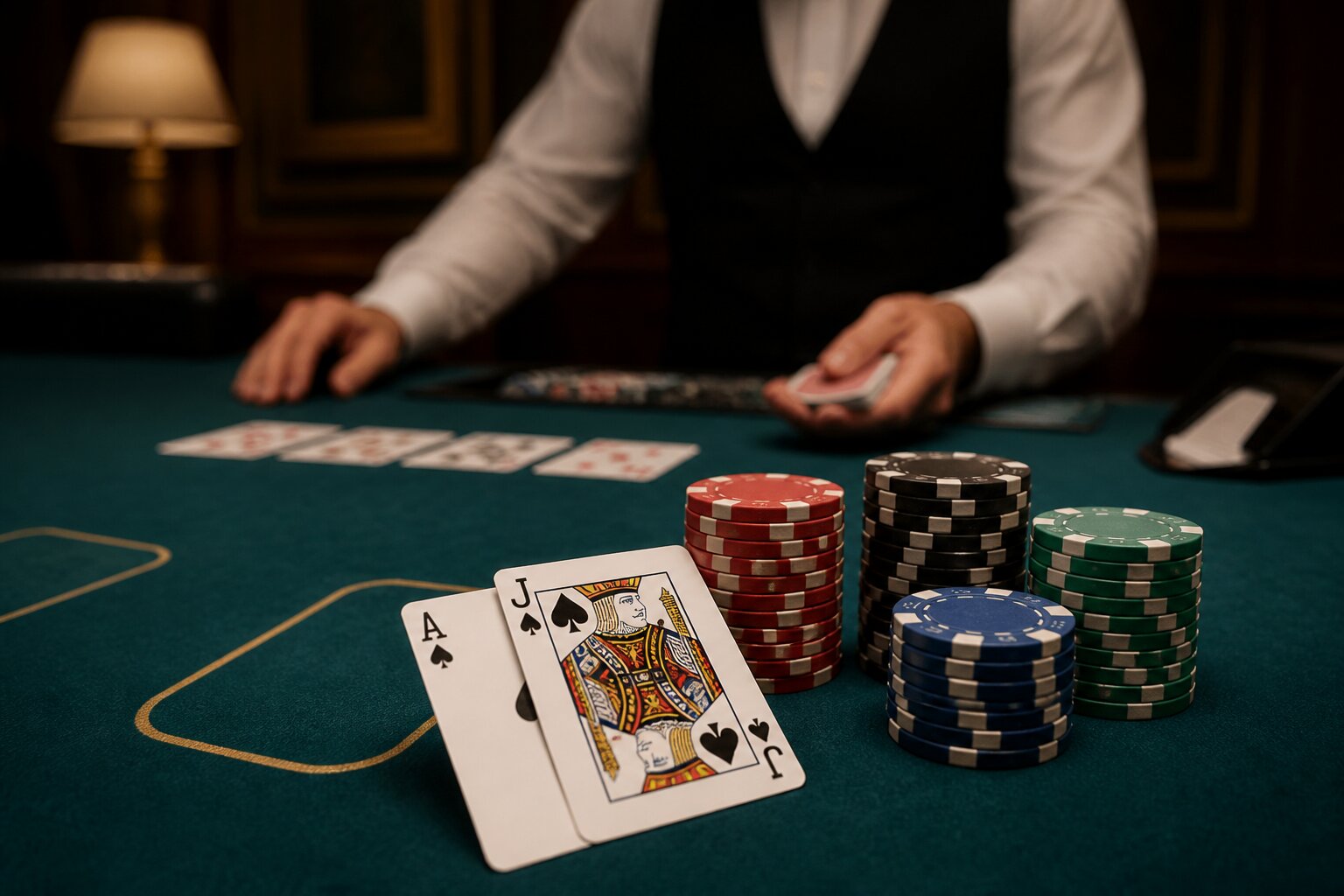
The most familiar payout applies to a natural blackjack, which is an ace plus a ten-value card in your first two cards. Traditionally this pays 3:2. That means a £10 stake produces £15 in winnings, plus your original bet is returned. Some tables instead pay 6:5, where a £10 stake yields £12 in winnings. Although the amounts seem similar, the difference compounds over many hands.
If you beat the dealer with a higher hand that is not a natural, you are paid at even money, 1:1. A £10 bet that wins returns £10 in winnings and your £10 stake. Insurance is offered when the dealer shows an ace; this is a separate side wager that pays 2:1 if the dealer has a blackjack. Because it is distinct from the main bet, insurance changes the overall mathematics of the round and should be considered on its own terms.
Why Do Some Tables Offer Different Blackjack Payouts?
Tables vary because each game sets its own combination of rules. Casinos and game providers adjust payouts to reflect different rule sets, deck counts and dealer behaviour. For instance, a table that pays 6:5 for a natural may also allow the dealer to take another card on a soft 17 or use more decks, and those choices increase the casino’s advantage.
Some variations add side features or quicker play formats and compensate by changing payouts. These adjustments are not arbitrary; they are mathematical choices that shift the long-term balance between player and house. Before you join a table or click to play, look for the paytable and rule list so you know how the payout structure interacts with the other rules.
How Do Blackjack Odds Affect Your Winnings?
Blackjack odds express the likelihood of different outcomes and, together with payout ratios, determine the value of each result. A higher payout for a natural blackjack raises the reward for that outcome, while a lower payout reduces it. Odds and payouts are two parts of the same equation: one describes probability, the other describes reward.
It helps to view odds as statistical probabilities rather than guarantees. Outcomes are governed by the game’s random dealing process, so predictions are about likelihoods over many hands rather than certainty in any single round. Keeping this in mind makes it easier to compare tables and choose the rules that suit your preferences and budget.
What Is the House Edge in Blackjack?
The house edge quantifies the casino’s long-term advantage on a particular set of rules. It is expressed as a percentage of each bet that the casino expects to retain over a long series of hands. For traditional blackjack with favourable rules and perfect basic strategy, this margin can be quite small, often around 0.5 percent. When rules change—fewer favourable payouts, more decks, or a dealer hitting on soft 17—the percentage rises.
This metric is a long-run average. Short sessions can produce wins or losses well beyond that figure, but the house edge explains why, over many rounds, casinos expect to retain a predictable share of stakes. Knowing the house edge for a table helps you make informed choices about which games offer the best theoretical returns.
How Is the House Edge Calculated?
Calculations for the house edge combine the probabilities of every possible hand outcome under a given rule set and the payouts assigned to those outcomes. Analysts consider deck composition, whether doubling after splitting is allowed, surrender options, how the dealer plays soft hands and the payout for natural blackjacks. All of these inputs create a comprehensive model that produces the edge figure.
For example, the difference between a 3:2 and a 6:5 payout for a natural significantly changes the maths. Those changes are analysed across millions of hands to produce the edge percentages you’ll see quoted by experts. Keep in mind that these theoretical figures assume optimal play; deviations in decision-making will alter the practical results.
How Does Payout Ratio Impact the House Edge?
Payout ratios are a major lever in setting the house edge. A 3:2 payout reduces the house’s advantage compared with 6:5, because it increases the reward for one of the more valuable outcomes. Conversely, lower natural payouts raise the house edge and reduce the expected return to the player.
Other rule changes interact with payout ratios. For instance, more decks typically make certain favourable outcomes slightly less likely, and rules that limit doubling or splitting will further lift the house edge. Evaluating a table means weighing the payout ratio together with these other rule elements to see the combined effect on the expected return.
Are There Common Myths About Blackjack Payouts?
Several persistent misunderstandings circulate about blackjack payouts. One is that all tables pay the same; in truth, the mix of payouts and additional rules creates meaningful differences. Another myth is that betting systems can overcome the house edge. Systems that alter stake size do not change the underlying mathematics of the game.
Some players believe patterns in short-term results can be exploited to predict future outcomes. Because each hand is dealt independently, prior results do not change the probabilities for the next hand. Separating fact from fiction helps you focus on the practical details—paytables and rules—that genuinely affect long-term returns.
If you want to aim for the best value, prioritise tables with favourable payout ratios and player-friendly rule sets. Understanding common pitfalls makes it easier to spot when a surface-level improvement, such as an eye-catching side bet, actually worsens your long-term prospects.
How Can You Identify the Best Blackjack Payouts in UK Casinos?
To identify better-value tables, check the paytable and the full list of game rules before you play. Look first for a 3:2 payout on naturals rather than 6:5, and then scan for other favourable options: single-deck or fewer decks, dealer stands on soft 17, and liberal doubling and splitting rules. Those factors combine to produce a lower house edge.
Avoid relying on visible activity at a table as an indicator of future results. Instead, compare the numerical rules and payouts across available tables. If online, the game information or help section should list the payouts and rule details. Make choices that align with the level of variance and potential returns you are comfortable with.
Understanding Side Bets: Do They Change the Payout Structure?
Side bets are optional wagers resolved separately from the main hand and typically offer higher nominal payouts for rarer card combinations. Examples include bets on pairs, suited combinations or poker-style three-card hands. The advertised odds for these bets can look attractive, but they generally come with a larger house edge than the main blackjack wager.
Because side bets use different probability profiles, they alter the overall expectancy when included. Players who choose side bets should read the paytable carefully to understand the true value of each option. If you prefer a more mathematically favourable game, prioritise the main hand rules and treat side bets as optional extras that change the session’s variance and expected return.
Summary of Key Points: Maximising Value with Blackjack Payouts
Understanding payout ratios, how they interact with the rules and where side bets fit into the picture helps you make informed choices at the table. A 3:2 payout for a natural is preferable to 6:5, and other dealer and deck rules will further influence the house edge. Side bets offer larger one-off payouts but usually increase the casino’s advantage.
By checking paytables and rule sets before you play, you can select tables that match your preferences for risk and potential return. Set clear limits on stakes so your play stays within what you can afford. With the rules in front of you and a clear idea of how payouts affect value, you can enjoy the game with a better understanding of what the numbers mean.
**The information provided in this blog is intended for educational purposes and should not be construed as betting advice or a guarantee of success. Always gamble responsibly.