
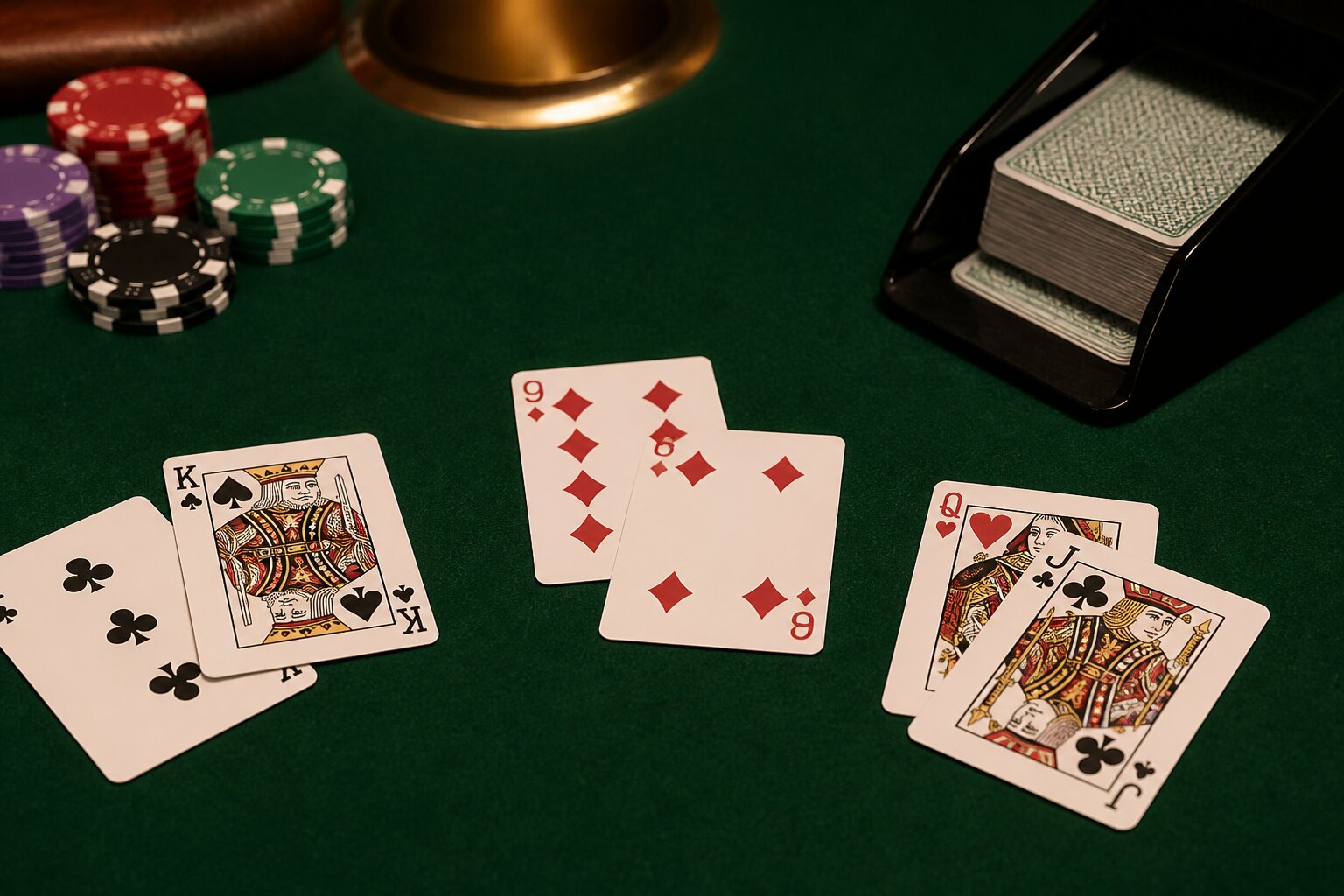
Ever wondered why some players make blackjack look effortless? It comes down to knowing how each card contributes to your hand so you can add up totals without hesitation. A simple slip, like treating a Jack as a number card or misreading an Ace, can change how you decide to play a hand.
The aim is straightforward: get closer to 21 than the dealer without going over. Once you understand how card values work, the maths becomes second nature and your choices at the table are clearer and faster.
Read on to learn the exact values, how special cards behave, and examples that make adding up hands quick and reliable.
What Are the Card Values in Blackjack?
Blackjack keeps card values simple and consistent.
Number cards (2 to 10): each is worth its face value. A 4 counts as four, a 9 counts as nine.
Face cards (Jack, Queen, King): all count as 10, regardless of suit.
Aces: the flexible card, counting as either 1 or 11 depending on which gives a better total without exceeding 21. This flexibility means an Ace can prevent a hand from busting or boost a hand’s total closer to 21.
With those rules in mind, you can calculate any starting hand quickly. For example, an Ace and a 6 can be counted as 7 or 17, while an Ace and a 10 is an automatic 21. These variations are commonly described as soft and hard totals: a soft total includes an Ace that can still be counted as 11 without busting, whereas a hard total either has no Ace or has an Ace that must count as 1.
Recognising when a hand is soft or hard is important for assessing its potential. The next section looks more closely at that flexibility and why Aces are the most important card to recognise.
How Are Aces Counted in Blackjack?
Aces can be counted as 1 or 11, chosen to produce the best total that does not exceed 21. If an Ace pairs with a 10-value card (10, Jack, Queen, King), the Ace is counted as 11, giving a two-card total of 21, known as a blackjack.
If the hand would otherwise go over 21, the Ace is treated as 1. For example, an Ace with an 8 and a 9 becomes 1 + 8 + 9 = 18. That adaptability lets an Ace either protect a hand from busting or lift it to a stronger total.
When you have more than one Ace, the same rule applies. Two Aces are usually counted as 11 + 1 for a total of 12, because counting both as 11 would exceed 21. With several Aces, the cards are evaluated so the overall total stays at or below 21 whenever possible.
Understanding this switching behaviour is essential before you consider how fixed-value face cards affect totals. It is a fundamental part of evaluating whether a hand is a soft hand, where an Ace can still change value, or a hard hand, where changing an Ace would not be possible without busting. Being familiar with these distinctions helps you read hands more accurately.
How Do Face Cards Affect Your Hand?
Face cards always add ten to your total. A King and a 7 make 17; a Queen with an Ace can form a 21 if the Ace is counted as 11. In games where a two-card 21 is treated specially, a face card plus an Ace may be considered a blackjack and scored differently from other 21s.
Because face cards have a fixed value, they simplify calculations but also raise the chance of exceeding 21 when combined with other high cards. This fixed value means fewer permutations to consider when deciding whether to hit, stand or take other options, but it also makes high totals more likely if you draw additional cards.
Knowing when a face card completes a strong two-card total or when it risks pushing you too high helps inform sensible choices during play. It is also worth remembering how Aces behave, since their flexible value often determines whether a hand containing a face card is safe to play on or needs to be played cautiously.
Next, see clear examples that put these rules into practice with common hand combinations.
Hand Value Examples: How to Add Up Your Total
Putting the rules into examples makes adding up hands straightforward.
An 8 and a 7 total 15 by simple addition. Two 10-value cards – for example a 10 and a Queen – add to 20. An Ace and an 8 can be counted as 9 or 19; unless doing so would bust the hand, the Ace is taken as 11, so this reads as 19. A hand containing 2, 3, 6 and 10 adds to 21 (2 + 3 + 6 + 10 = 21).
You can work through slightly more complex hands the same way. For instance, a hand with a 9, a 7 and a 5 adds to 21 but would bust if you drew another card. A hand with two Aces and a 9 can be counted as 21, because one Ace is 11 and the other is 1, giving 11 + 1 + 9 = 21. If you have three Aces and a 6, that is counted as 19 (11 + 1 + 1 + 6 = 19) to avoid going over 21.
Practising these combinations aloud or visualising them briefly before acting helps speed up calculations and reduces errors. Taking a moment to re-add a hand in your head when play gets brisk is a useful habit that lowers mistakes and keeps decisions clear.
The next section explains how the presence of an Ace changes how a hand is described and treated at the table.
Soft vs Hard Hands: What’s the Difference?
The distinction depends on whether an Ace can still be counted as 11 without busting.
A soft hand contains an Ace valued at 11. For example, Ace plus 6 is a soft 17, because the Ace can later be reverted to 1 if another card would otherwise push the total over 21. This flexibility gives room to take another card without the same risk as a hard hand.
A hard hand either has no Ace or has an Ace that must be counted as 1 to avoid exceeding 21. A 10 and a 7 form a hard 17. A hand such as Ace, 7 and 10 is hard 18 because the Ace is forced to the value of 1.
With that in mind, consider how pairs introduce a different decision - splitting - which changes how individual cards are handled and how many hands you manage in a round.
What Happens with Pairs and Splitting?
When your first two cards are the same rank, such as two 8s or two Kings, some games allow you to split them into two separate hands. Each new hand receives another card, and each is played independently with its own stake.
Can You Split Any Pair in Blackjack?
Most blackjack rules let you split most pairs. Two 8s can be split into two hands each starting with an 8. Two 10-value cards may also be split, though many players choose not to because the original pair already makes a strong total. Two Aces can usually be split, which creates two hands that each start with an Ace.
House rules can restrict options, for example by limiting how many times you can re-split or placing special conditions on split Aces. It is wise to be aware of these variations before deciding to split.
How Does Splitting Affect Your Hand Value?
Splitting turns one hand into two separate contests against the dealer. If you split two 8s, you no longer have a single total of 16; instead, you have two hands that start at 8 and each develops independently as new cards are dealt. This affects both strategy and the amount you have at risk, since each split hand requires its own bet.
Understanding the practical impact of splitting helps frame decisions about both potential reward and exposure in a round. The following section answers common questions that often arise once you can read hand values confidently.
Common Questions About Hand Values
This section addresses frequent queries to clear up typical points of uncertainty.
What Is a Blackjack?
A blackjack is a two-card total of 21, made by an Ace plus any 10-value card. It is the strongest initial hand and normally pays out at higher odds than a regular win, provided the dealer does not also have a blackjack.
What Happens If You Go Over 21?
If a hand’s total exceeds 21, the hand busts and is removed from contention for that round. For example, a 9, a 7 and a 6 total 22, which means the hand immediately loses. Being aware of how different cards add up, and recognising when an Ace can avert a bust, helps keep decisions measured and consistent.
Having a solid grasp of card values, how Aces can switch between 1 and 11, and when splitting makes sense will make your play clearer and more confident. That knowledge pulls everything together and leaves you ready to approach each hand with a steady head and accurate totals.
Play Online Casino Games at UK Online Slots
We’d love to welcome you to UK Online Slots, where you can enjoy the excitement of online casino games with us in a safe and friendly environment. Take a look around and see what our site has to offer.
Getting started is easy: just create an account, make a deposit and you’re all set to join in the fun. We look forward to having you with us.
**The information provided in this blog is intended for educational purposes and should not be construed as betting advice or a guarantee of success. Always gamble responsibly.