
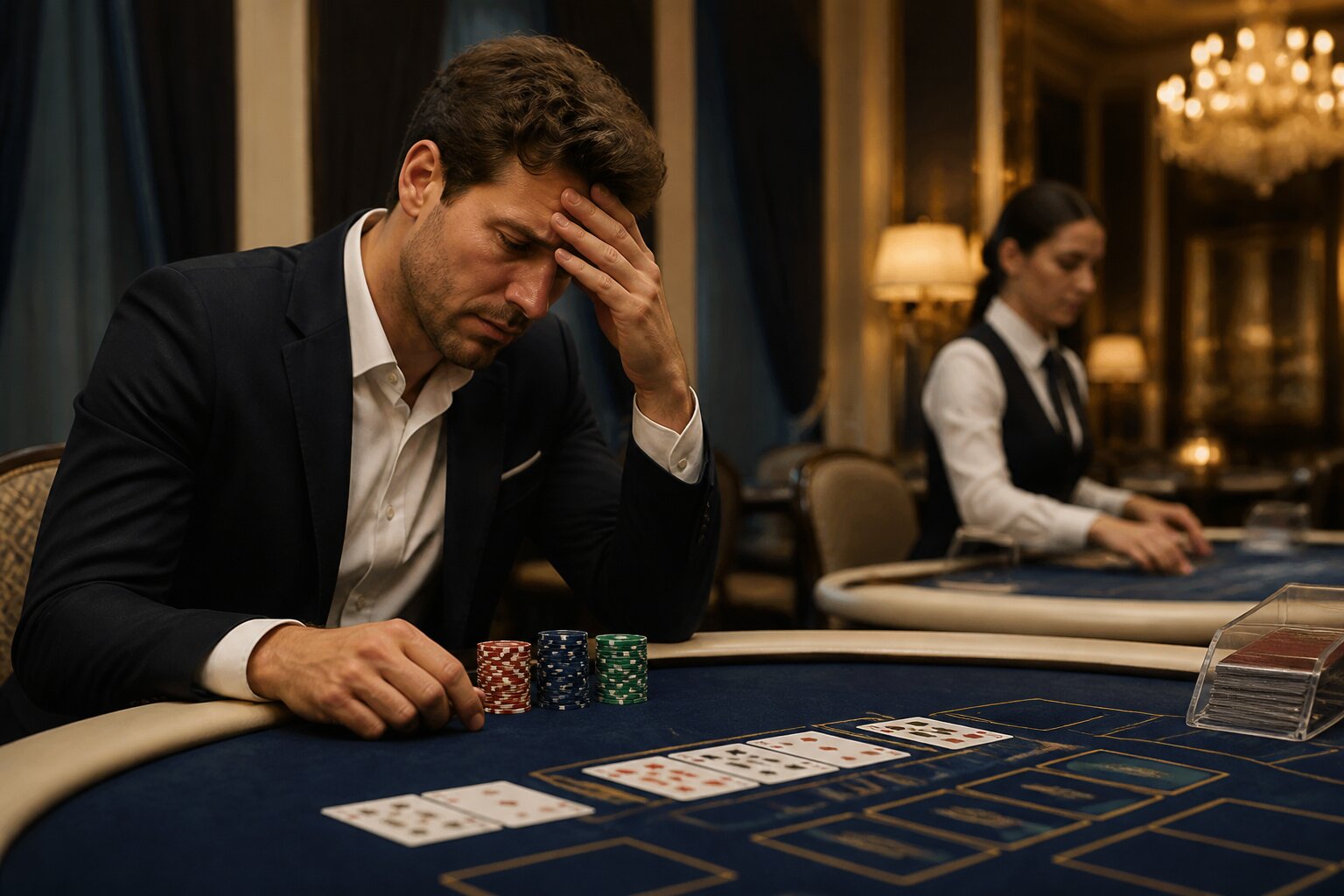
Ever sat at a baccarat table and wondered, "How likely is it to lose hand after hand?" Those stretches of consecutive losses can rattle anyone — whether new to the game or experienced. They feel dramatic, but they follow measurable probability.
This article breaks down the real numbers behind losing streaks in baccarat. Read on to learn how to calculate consecutive-loss probabilities, how different bets and game features affect those odds, and practical ways to manage tough runs at the table.
What Are Losing Streaks in Baccarat?
A losing streak in baccarat means losing several bets in succession. If a player backs the Player hand three times and each bet loses, that is a three-hand losing streak. The same concept applies to Banker, Tie, and any side bets.
Each hand is an independent event: the outcome of one hand does not change the odds for the next. This independence is often misunderstood and leads players to expect patterns that don’t exist — a misconception commonly called the "gambler’s fallacy". Recognising that every deal is separate helps keep expectations realistic.
Losing runs are a normal statistical occurrence. They do not indicate bias in the game or signal that future hands will reverse the trend. Understanding this will keep you clearer-headed at the table and better prepared for what to expect next. Coming up, we’ll translate that idea into the actual maths used to estimate streak chances.
Understanding the Odds: How Is the Probability of Consecutive Losses Calculated?
Because each hand is independent, the probability of losing several times in a row is the single-hand losing probability multiplied by itself for each successive loss. For example, if the chance of losing one Player bet is 50.68%, the probability of losing three Player bets in a row is 0.5068 × 0.5068 × 0.5068, which is about 13% (roughly 1 in 8).
The same multiplication principle applies to any streak length: add another loss, multiply by the single-hand losing probability again. This simple rule shows why short runs of losses are relatively common while very long streaks become progressively rare.
The next subsection explains how the house edge and bet type shape that single-hand losing probability, which in turn governs streak likelihood.
The Role of House Edge and Game Structure
Each bet in baccarat carries a built-in house edge that slightly alters the chance of winning or losing a single hand. The Player bet has a house edge around 1.24%, and the Banker bet about 1.06% when standard commissions are applied. These figures mean the casino has a small advantage on each bet over the long term.
The game’s structure — the drawing rules and the balance between Player and Banker outcomes — keeps the Player and Banker bets close to even. That near-balance results in a single-hand losing probability near 50% for those main bets, which moderates the frequency of short losing streaks compared with bets that have a much higher house edge.
Tie bets are a different case: they win far less often and carry a substantially higher house edge, which makes consecutive losses much more common for that market. The next part compares those bet types more directly so you can see how they affect streak length.
Differences Between Banker, Player, and Tie Bets
The Banker and Player bets are very similar in win/loss likelihood after accounting for ties, with both having single-hand losing probabilities close to 50.7%. The Tie bet, by contrast, wins only rarely and therefore has a much higher losing probability — typically about 85.64% — and a house edge in excess of 14%.
Because of this, strings of losses are far more likely on the Tie bet than on Banker or Player. Players who want steadier outcomes generally prefer Banker or Player wagers; those who choose Tie should expect more frequent losing runs and larger variance. With that comparison in place, let's look at concrete examples of streak probabilities across common lengths.
How Likely Are Long Losing Streaks in Baccarat?
Losing streaks of any length can occur, and their probabilities fall quickly as the required number of consecutive losses increases. Short streaks — two or three hands — are fairly common and will happen in normal play. Streaks of ten or more are uncommon but entirely possible over a long run because randomness can produce clusters of similar outcomes even when each hand is independent.
Even though long runs are rare, they are an expected feature of random processes. Over many sessions and many players, some will experience unusually long sequences of losses simply by chance. That does not indicate a flaw in the game; it is a mathematical consequence of repeated independent trials.
Probability Examples for 2, 5, 10, and 15 Losses
The table below gives rounded probabilities for consecutive losses on the main baccarat markets, using typical single-hand losing chances.
| Number of Losses | Player Bet | Banker Bet | Tie Bet |
|---|---|---|---|
| 2 | 26% (1 in 4) | 26% (1 in 4) | 99% |
| 5 | 3% (1 in 33) | 3% (1 in 33) | 97% |
| 10 | 0.1% (1 in 1,048) | 0.1% (1 in 1,048) | 93% |
| 15 | 0.003% (1 in 32,768) | 0.003% (1 in 32,768) | 86% |
These figures use the following single-hand losing probabilities: Player ≈ 50.68%, Banker ≈ 50.68% (after ties), Tie ≈ 85.64%. Because those single-hand probabilities are applied repeatedly, the chance of a long consecutive losing run decreases exponentially with length. That rapid drop in probability for longer streaks explains why very long runs are rare, though they remain possible given enough hands.
It is also worth noting that rounding and the specific shoe composition can shift the exact numbers slightly. The table is intended to give a clear, practical sense of how quickly probabilities shrink as streak length increases, rather than to present exact figures for every possible game configuration.
Understanding how bet choice affects these numbers is helpful when deciding which markets to play; next, we’ll examine whether table size or deck count changes the picture in any meaningful way.
Impact of Bet Type on Streak Likelihood
Choice of bet is the largest factor in how often losing streaks occur. Player and Banker produce similar streak profiles because their single-hand probabilities are close, while Tie produces a much higher frequency of losses due to its much lower chance of winning.
For players seeking lower variance, the main bets on Player and Banker are generally preferable to the Tie or exotic side wagers. The higher loss frequency on Tie means longer losing runs are far more likely if you back that market, which increases volatility even though the potential payout is higher.
Remember that no bet choice can eliminate the possibility of streaks. All outcomes remain governed by probability and the house edge, so risk management and sensible staking are important considerations when playing.
Does Table Size or Deck Number Affect Losing Streak Odds?
The number of players at a baccarat table does not affect the odds of any individual hand. Each hand follows the game’s drawing rules and is independent of who or how many people are betting. That means table size has no statistical effect on your chance of encountering a losing streak.
Number of decks — commonly six or eight in casino games — has only a tiny influence on outcome probabilities. The house edge and single-hand losing probabilities change marginally with deck count, but not enough to alter practical expectations about streaks. For example, Banker’s house edge with six decks is about 1.06% and remains close to that with eight decks.
So while the environment at the table or the number of decks may feel significant, they do not meaningfully change your risk of consecutive losses. With that settled, the final main section outlines sensible ways to manage losing runs when they happen.
How to Cope With Losing Streaks When Playing Baccarat
Managing losing streaks is about preserving enjoyment and protecting finances. Set a clear gambling budget beforehand and treat play as entertainment with a fixed cost. Establish a loss limit for each session and stop once that limit is reached to avoid chasing losses, which often leads to worse outcomes.
Breaks during a session help maintain perspective and prevent emotionally driven decisions. If losses start to affect mood, sleep, relationships or finances, seek help: there are neutral support services and tools offered by regulators and harm-prevention organisations, such as deposit limits, time-outs and self-exclusion. Practical changes like lowering bet size or switching to lower-variance markets can also reduce exposure.
Keeping play within set boundaries preserves the experience and helps ensure gambling remains a controlled activity. The final section below points you to a place to try baccarat with those safeguards in place.
Play Baccarat Online at UK Online Slots
Find a selection of live-dealer and digital baccarat games at UK Online Slots, ranging from classic tables to modern presentations. Games are offered for players aged 18 and over and are run under licence with standard consumer protections and tools to help control play.
If you use the site, set limits that suit your budget and make use of available responsible-gambling features such as deposit controls and time-outs. With sensible safeguards in place, you can explore baccarat’s gameplay and see how the probabilities described here play out in practice.
Baccarat’s streaks are a statistical fact, not a sign of anything else; understanding the odds and managing your play helps keep the experience straightforward and enjoyable.
**The information provided in this blog is intended for educational purposes and should not be construed as betting advice or a guarantee of success. Always gamble responsibly.