
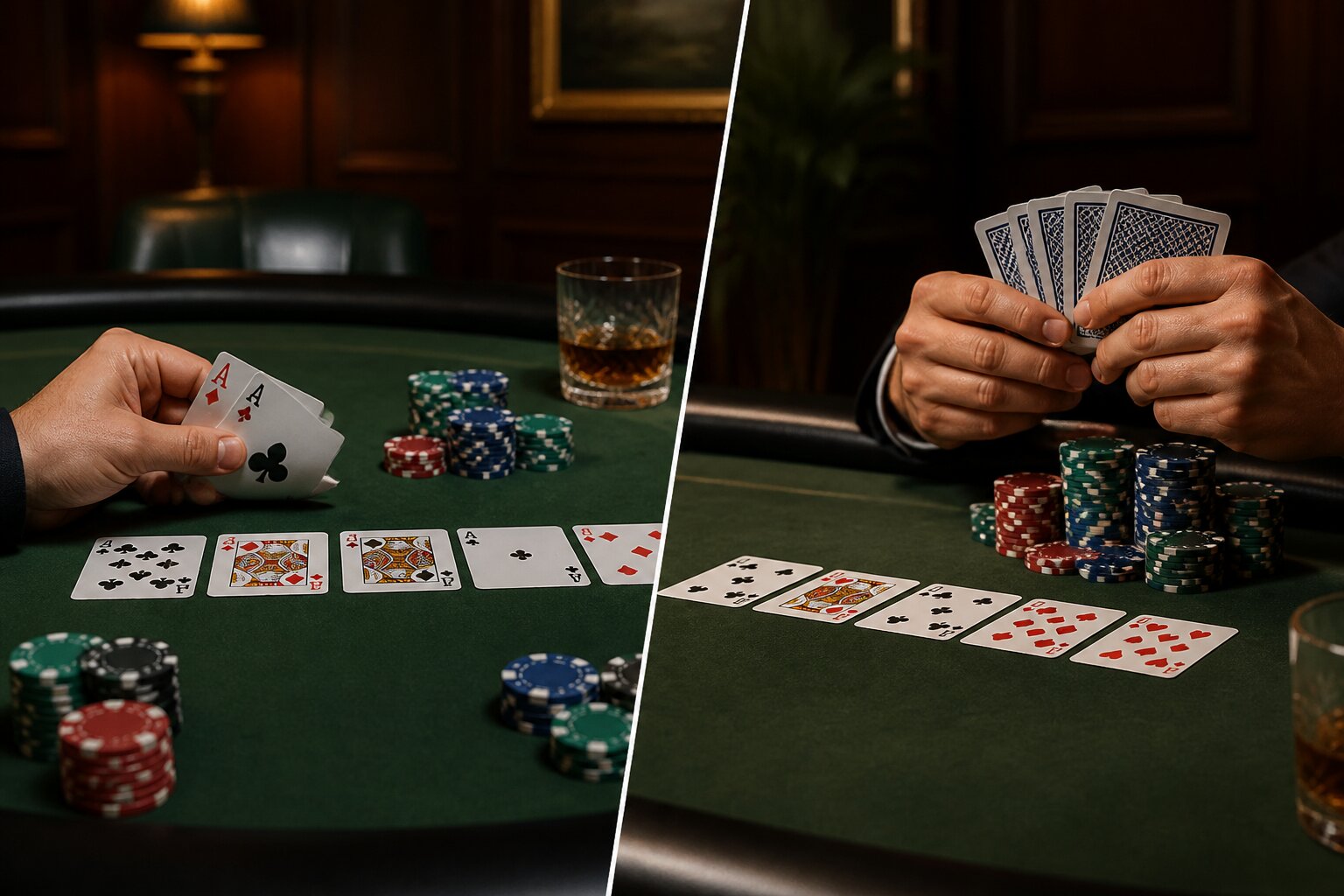
Have you ever sat down at a card table only to find yourself baffled by the rules? You’re not alone. Whether it’s a home game with mates or a night out at the casino, “poker” can mean different things to different people.
For many, Texas Hold’em springs to mind straight away, but other versions—often called “regular poker”—play very differently. Before risking your chips on the next game, it helps to know what sets Texas Hold’em apart and why those differences change the way you should think at the table.
What Is Regular Poker Compared to Texas Hold'em?
When people say “regular poker” they usually mean classic versions such as Five Card Draw or Seven Card Stud, games that predate the widespread popularity of Texas Hold’em.
In Five Card Draw each player receives five private cards. After an initial round of betting, players can swap some cards for new ones in an attempt to improve their hand. There are no community cards and everything you hold is hidden, which places a heavy emphasis on reading opponents from betting patterns and timing.
Seven Card Stud deals seven cards to each player across several rounds, with a mix of face-up and face-down cards. Players assemble the best five-card hand from those seven, and the visible cards shape decisions and bluffing opportunities in a different way to games with shared cards.
Texas Hold’em gives each player two private “hole” cards and places five community cards face up in the centre for everyone to use. That shared board creates more visible information, different bluffing dynamics and a wider range of hand combinations.
These contrasts affect tempo, psychology and strategy in distinct ways, and they lead naturally to the detailed rule differences that follow.
Core Rules: How Do the Games Differ?
The key differences lie in how cards are dealt, how hands are constructed and how betting unfolds.
In Texas Hold’em each player gets two hole cards and five community cards are revealed in stages: the flop (three cards), the turn (one card) and the river (one card). Players make their best five-card hand from any combination of hole and community cards. Betting occurs after the deal and after each community card is revealed, with the pot going to the best hand at showdown or to whoever forces all others to fold.
Five Card Draw deals five private cards to every player. After a betting round, players can discard and draw replacements before a final betting round and showdown. Because there are no shared cards, the game centres on private decision-making and inference.
Seven Card Stud gives each player seven cards across several rounds, some face up and some face down, and no community cards. The visible cards influence betting as players judge the likelihood of rivals’ hands. The best five-card selection from the seven wins at showdown.
Betting structures differ too. Hold’em commonly uses blinds—two forced bets that rotate around the table and set the initial stakes. Draw and Stud variants typically use antes or bring-ins to seed the pot. With those basics covered, the next section looks closely at exactly how many cards and rounds each game uses.
Card Dealing & Betting Rounds Explained
How cards are distributed and when bets are placed define much of a game’s feel. These mechanics change how information is revealed and when strategic choices must be made.
How Many Cards Do Players Receive?
In Texas Hold’em, each player begins with two private hole cards; the five community cards are revealed in stages for everyone to use. That shared element makes it possible to see common possibilities and adjust betting accordingly.
In Five Card Draw players receive five private cards and keep their holdings secret from others. The draw phase lets players alter their hands, which can shift the balance between risk and reward.
Seven Card Stud starts players with three cards (two down, one up) and proceeds to deal further cards—four face up and the remaining face down—until each player holds seven. The visible cards provide information that affects betting choices as the hand develops.
What Are the Betting Rounds in Each Game?
Texas Hold’em follows four betting rounds: pre-flop (after hole cards), flop (after three community cards), turn (after the fourth community card) and river (after the fifth). That rhythm produces many decision points and frequent changes in hand strength.
Five Card Draw normally has two betting rounds: one before the draw and one after players exchange cards. Because there are fewer betting streets, each decision tends to carry proportionally more weight.
Seven Card Stud includes five betting rounds, interspersed with the deals of face-up and face-down cards. The staggered revelation of upcards creates shifting information sets, making the game more incremental and observational.
With these structures clear, it becomes easier to compare how hand values are judged across variants.
Understanding Hand Rankings
Most classic poker variants use the same hierarchy of hand rankings to determine winners. Success depends on combining skill with the cards you are dealt and on interpreting opponents’ behaviour.
The hand rankings, from highest to lowest, are:
Royal Flush
Ace, King, Queen, Jack, Ten all of the same suit. Example: A♦ K♦ Q♦ J♦ 10♦
Straight Flush
Five consecutive cards of the same suit. Example: 6♠ 7♠ 8♠ 9♠ 10♠
Four of a Kind
Four cards of the same rank. Example: 9♣ 9♦ 9♥ 9♠ 2♠
Full House
Three of a kind plus a pair. Example: 8♠ 8♥ 8♦ 4♣ 4♠
Flush
Any five cards of the same suit (not in sequence). Example: 2♥ 6♥ 9♥ J♥ Q♥
Straight
Five consecutive cards in mixed suits. Example: 3♠ 4♣ 5♦ 6♥ 7♠
Three of a Kind
Three cards of the same rank. Example: 5♣ 5♠ 5♦ K♥ 2♦
Two Pair
Two pairs plus a fifth card. Example: 7♣ 7♠ 3♥ 3♦ J♣
One Pair
Two cards of the same rank. Example: 10♠ 10♦ 6♣ 8♣ 2♥
High Card
If no other hand is made, the highest single card wins. Example: A♠ 7♦ 6♣ 3♣ 2♥ (ace high)
Knowing these rankings lets players compare hands across variants and judge when a bet is justified. Next, consider how table size and seating affect the game’s rhythm and strategy.
Table Setup & Player Numbers
Table layout and the number of players alter how a game plays. These practical details influence card distribution, pace and the range of viable tactics.
Texas Hold’em tables typically seat between 2 and 10 players, which suits both heads-up confrontations and full-ring games. The rotating dealer button and fixed Blinds create a steady flow of forced action that keeps pots moving.
Five Card Draw generally works best with 2 to 6 players. Smaller groups mean more deck availability per hand and quicker rounds, making it a common choice for casual home games.
Seven Card Stud usually caps at around 8 players because each participant can receive up to seven cards; the limit prevents running out of cards in a single deck. The smaller maximum also slows the tempo and rewards careful observation of visible cards.
Seat numbers and table shape do more than fill a room: they shape hand ranges, bluff frequency and how aggressive players can be. With that in mind, understanding the terminology each version uses helps make the game less confusing.
Common Terms Used in Each Version
A shared vocabulary keeps play smooth and avoids misunderstandings. The following terms are central to the variants already described and will make following a hand much easier.
Texas Hold’em Terms
Blinds: Mandatory bets made by two players to the left of the dealer that initiate action. These rotate after each hand.
Flop: The first three community cards dealt face up.
Turn: The fourth community card dealt face up.
River: The fifth and final community card dealt face up.
Hole Cards: The two private cards each player receives.
Check: Passing action to the next player without betting when no bet is outstanding.
All-In: Committing all remaining chips to the pot.
Terms Used in Draw and Stud Poker
Draw: Swapping selected cards for replacements in draw variants.
Stand Pat: Declining to exchange any cards in a draw game.
Ante: A small forced bet all players contribute to start the pot.
Bring-In: A compulsory bet in stud that is typically made by the player showing the lowest upcard.
Showdown: When remaining players reveal hands to determine the winner.
Upcard/Downcard: Cards dealt face up or face down respectively, especially in stud games.
With the language understood, the next section explains why different games attract different players and settings.
What Makes Each Game Popular?
Each variant attracts players for different reasons tied to pace, complexity and social setting.
Texas Hold’em’s popularity comes from its balance between straightforward rules and deep strategic layers. The shared community cards create frequent decision points and opportunities for varied betting tactics, which appeals to players who enjoy both quick reads and longer-term planning. Its flexible table sizes make it easy to find games in pubs, clubs and online.
Five Card Draw’s simplicity is its strength. New players often learn with Draw because the rules are concise and the focus remains on private hand management. It suits smaller, casual gatherings where rounds are brisk and the emphasis is on sociable play.
Seven Card Stud rewards attention to detail. The staggered deal and visible upcards mean players track multiple information sources and adapt as a hand develops. That measured pace attracts players who prefer slow, information-rich contests over the faster swings of community-card games.
Across all versions, poker remains a social activity built on skill, strategy and reading opponents rather than any guaranteed outcome. If you plan to join a game, set a pre-defined limit on stakes and stick to it; keeping play within sensible boundaries lets you enjoy the challenge without risk.
Play Online Casino Games at UK Online Slots
We would love for you to become part of our friendly community of players at UK Online Slots. Share the enjoyment of online casino gaming with us and discover what our site has to offer.
Getting started could not be easier: simply create your account, make a deposit and choose your preferred games to play. We look forward to welcoming you and making your experience with us entertaining and enjoyable.
**The information provided in this blog is intended for educational purposes and should not be construed as betting advice or a guarantee of success. Always gamble responsibly.