
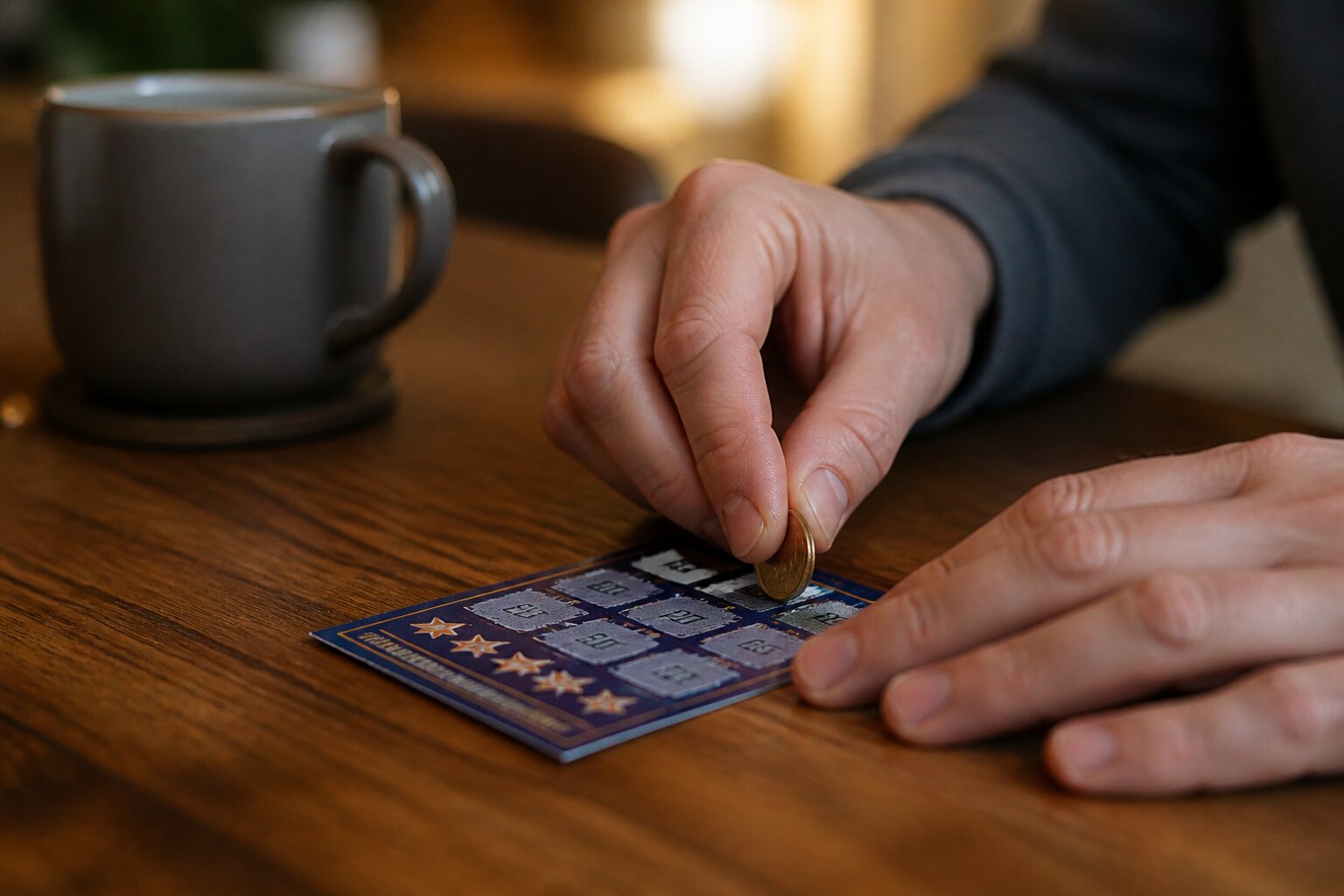
Have you ever bought a scratch card at the till and felt the brief pull of possibility as you reveal the symbols? The quick, tactile nature of the game makes the outcome feel immediate and dramatic, even when the odds are set by design.
Understanding how those odds work turns the experience from a guessing game into something more transparent. That knowledge doesn’t remove the excitement, but it does help you make clearer choices about how much to play and what to expect.
Read on to see how scratch cards are put together, what the numbers printed on them really mean, and how payouts are handled — all of which explain why big wins are so rare and small prizes more common.
How Do Scratch Cards Work?
Scratch cards are one of the simplest types of gambling available. A physical card has a thin opaque coating that you remove to reveal symbols, numbers or prize amounts. The combination you expose determines whether you win and what you win.
Digital instant-win games replicate the same idea on-screen. Instead of scratching with a coin, you click to reveal symbols. Behind the scenes, the outcome is determined before you view it, so the revealed result reflects a pre-set outcome rather than being created at the moment you click.
Both formats produce independent outcomes: each card or play has its own result that does not influence the next one. That independence is important because it means previous wins or losses don’t change the likelihood of future wins.
Now that the basic mechanics are clear, the next section looks at how those mechanics are expressed as odds and RTP — and how to read them so you know what you’re actually buying.
Scratch Card Odds Explained
Odds on a scratch card tell you how often a prize of any value is expected to appear within a batch of cards. When a card states “1 in 4,” it means that, on average across the full print run, one in every four cards offers some prize. That prize could be small or large; the odds figure covers all prize levels combined.
A separate but related number is RTP — Return to Player. This percentage indicates how much of the total money spent on a particular game is paid back in prizes over time. For example, an RTP of 70% suggests that, across all players and all plays, £0.70 is returned for every £1 staked. RTP combines the frequency and size of wins to give a longer-term picture of returns, rather than predicting any individual play.
Knowing both the overall odds and the prize breakdown is useful. A game might have relatively frequent small wins yet a very slim chance of its top prize. Checking the prize structure helps set realistic expectations about what outcomes are likely, and how often larger prizes appear.
What Types of Scratch Cards Offer Different Chances?
Scratch cards vary by price, prize structure and features, and these differences affect the odds. Lower-cost cards typically offer smaller top prizes but proportionally more modest wins. Higher-cost or branded cards introduce larger jackpots and often carry lower odds for the top-tier amounts.
Retail cards are produced in finite print runs: a fixed number of tickets with a fixed allocation of prizes. That creates a clear relationship between total tickets and the quantity of each prize tier. Digital instant-win games can present a broader range of themes and bonus mechanics, and they usually display RTP and prize tables prominently so you can compare games more easily.
Different designs also influence play style. Some cards concentrate many small prizes to give frequent, modest returns, while others offer fewer payouts but the chance at a much larger sum. The next section compares physical and online formats to highlight how those structures are delivered in practice.
Physical vs Online Scratch Cards: Is There a Difference?
Physical and online scratch cards follow the same principles of prize distribution, but their delivery differs. Retail cards are produced in batches with a set number of winners distributed through the print run; players buy and reveal a physical ticket. Online versions rely on random number generators and can include thematic or interactive features not possible on paper.
Where the two mainly differ is in convenience and information access. Online games typically show RTP and prize breakdowns alongside the game, making it straightforward to check odds before playing. Physical cards require checking the back of the ticket or the operator’s public information to find the same details. Either way, the essential probabilities and payout structures remain comparable.
With format differences explained, the next section breaks down prize tiers so you can see how likely particular payouts are within any given game.
Prize Tiers: What Can You Actually Win?
Scratch cards are organised into prize tiers, from the smallest awards up to the top jackpot. Low-value prizes — for example, free tickets or a few pounds — are intended to be common enough to keep players engaged. Mid-range prizes (tens to low hundreds of pounds) appear less frequently, while top prizes are deliberately rare; some top-tier payouts might occur only once per hundreds of thousands or even millions of tickets.
The prize table for each game shows the number of prizes at each level and their associated odds. That table gives a clear picture of how likely you are to encounter a small return versus a life-changing sum. It also explains why a modest win can feel satisfying even while the chance of a very large payout remains remote.
Understanding the distribution of prizes leads naturally to questions about randomness and fairness, which is what the next section addresses.
Are Scratch Cards Really Random?
Licensed operators must meet strict standards to ensure randomness and fairness. For physical cards, prizes are placed across a print run so that winning tickets are mixed among non-winning ones; for online games, outcomes are determined by independently tested random number generators.
Both formats are audited and regulated, and operators publish prize availability information and payout information so players can see the intended distribution of wins. Randomness is therefore not an informal claim but a regulated requirement backed by testing and public reporting.
Knowing the games are designed to be fair helps put the game’s odds into context and explains why myths and misconceptions often arise — the following section examines some of the most persistent of those myths.
Common Myths About Scratch Card Winnings
There are a number of popular misconceptions about scratch cards. Addressing them helps clarify what players can and cannot expect.
-
“There’s a secret to picking a winning card.”
In practice, the position of a card on a display or the time you buy it does not influence its outcome. -
“All the big prizes are gone early.”
The number of top prizes is fixed for a print run or game, but operators update prize availability information, and top prizes can remain unclaimed for extended periods. -
“There’s a pattern to the wins.”
Each play is independent by design; perceived patterns are coincidences rather than exploitable cycles. -
“It’s easier to win small prizes than you think.”
Small prizes are more common than large ones, but their frequency varies by game and is never guaranteed on any single card. -
“Systems and tips can improve your chances.”
No system reliably changes the odds; the outcome is determined by the game’s structure and random processes.
Clearing up these myths makes it easier to interpret a game’s odds realistically. The next section explains how winners receive their money and what to expect after a successful reveal.
How Are Scratch Card Winners Paid Out?
Payout procedures depend on whether the win came from a physical ticket or a digital game. Small retail wins are often paid at the shop that sold the ticket. Larger claims typically require submitting the ticket to a central claims centre or using an official claim process, which may include identification checks and formal paperwork for verification before funds are released.
Online wins are usually credited directly to the player’s account, with withdrawals following standard account and identity verification procedures. Significant prizes involve extra checks to comply with regulatory and anti-money-laundering rules. Payment methods for larger wins are typically bank transfers, arranged after verification is complete.
All legitimate operators are obligated to process claims transparently and reliably, and official guidance tells players which routes to use depending on the prize size. With the administrative side covered, you’ll have a clear idea of what happens after a win is revealed.
No matter which type of scratch card you choose, knowing how games are built, what the odds mean, and how payouts are handled gives a clearer picture of what to expect and why big prizes are rare but possible.
Play Casino Games Online at UK Online Slots
We invite you to enjoy our wide selection of casino games, offering plenty of choice for every kind of player. At UK Online Slots, you can explore different ways to play and enjoy the entertainment on offer.
**The information provided in this blog is intended for educational purposes and should not be construed as betting advice or a guarantee of success. Always gamble responsibly.