
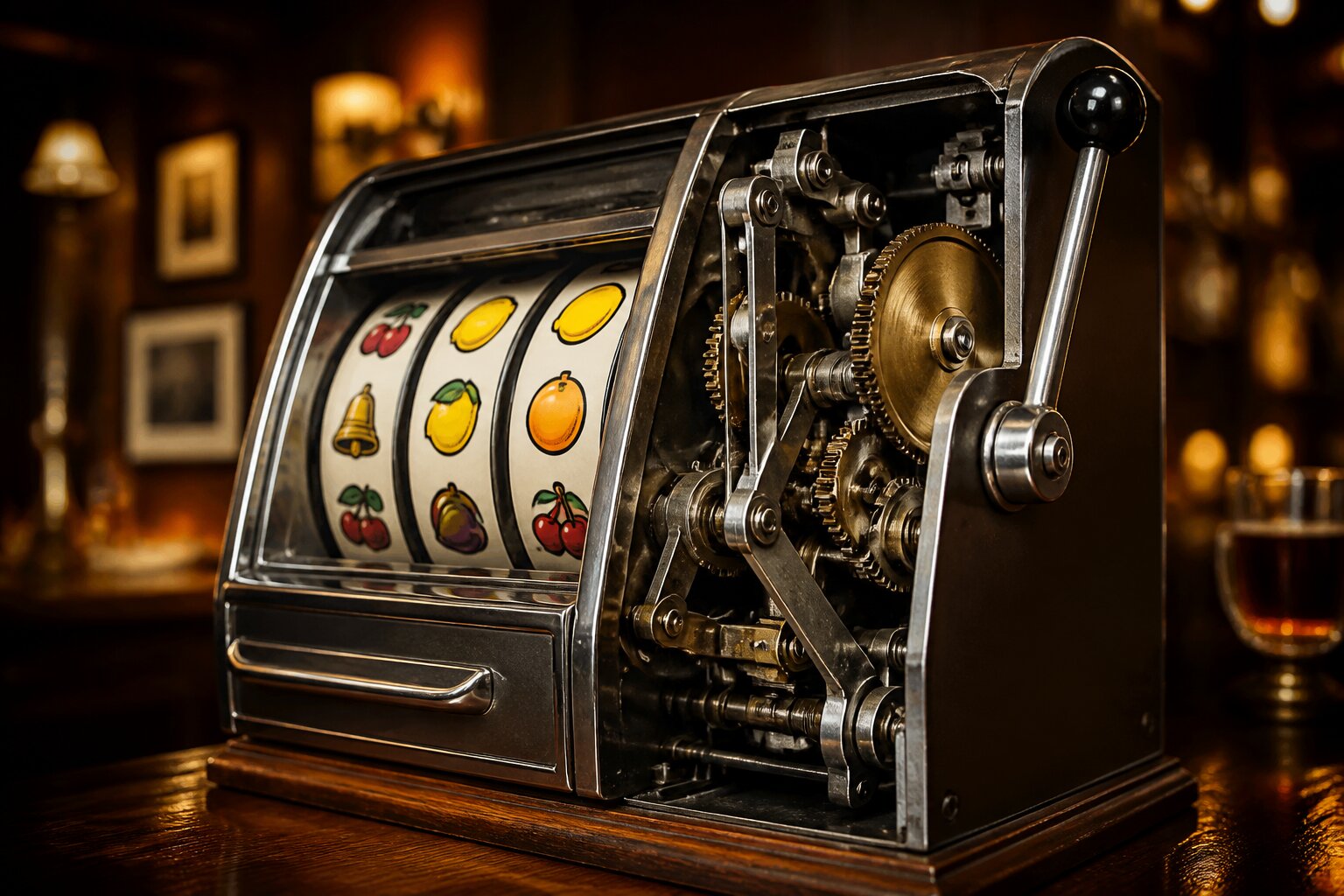
Ever wondered what’s happening inside those classic slot machines at the arcade or casino? Beyond the flashing lights and spinning reels there’s a compact system of mechanics designed to produce each spin and payout.
Mechanical slot machines combine simple engineering with careful calibration. In this article you’ll get a clear, behind-the-scenes look at the parts, the movement, and the rules that make these machines operate, so you can understand how each play is produced and resolved.
Read on to see how the components interact, how outcomes are produced, and what separates these vintage devices from the electronic machines that came after.
What Is a Mechanical Slot Machine?
A mechanical slot machine is a traditional gaming device that relies on physical reels and moving parts instead of digital displays or computer software. Pulling the lever sets gears, springs and stops in motion so each reel spins and eventually comes to rest at a particular symbol.
These machines do not use microchips or random number generators; their behaviour is governed by physical components and how those parts were configured during assembly. That mechanical simplicity gives them a distinctive feel and a very literal cause-and-effect design, where visible parts correspond directly to outcomes.
Mechanical models represent an earlier era of gaming technology. Most modern machines use electronics and software, but mechanical slots remain notable for their straightforward construction and the tactile way they reveal results.
Key Components Inside a Mechanical Slot Machine
Inside a mechanical slot machine several parts must work together precisely for each spin to behave as intended. The machine relies on mechanical linkages and timing rather than software to determine where the reels stop.
Reels
The reels are cylinders marked with symbols. Classic machines commonly use three reels, each mounted so it can rotate independently and show a strip of symbols as it turns. The symbol strips are fixed to the reel surface and the spacing of symbols defines the possible landing positions.
Each reel has its own axis and bearing, so friction and balance affect how it spins and slows. Small differences in weight distribution and wear over time can subtly change how a reel behaves, which is why machines are serviced and calibrated.
Lever
Often called the arm, the lever is the user control that initiates play. Pulling it engages internal linkages that transfer energy into the mechanism. The action typically moves a crank or pawl that sets the reels in motion and releases the escapement that allows them to rotate freely.
The lever also primes the timing elements and safety features, so nothing moves until the mechanism is correctly engaged. Modern versions may retain the lever for tradition while using different initiation methods, but the mechanical principle remains the same.
Gears and Springs
Gears translate the movement from the lever into rotational motion for the reels. They alter torque and speed so that a single pull can set multiple reels spinning, and they coordinate the timing between different parts of the mechanism.
Springs store and release energy to help control timing and to return parts to their ready positions afterwards. Common spring types used include coil springs for return actions and tension springs for timing elements. Together, gears and springs regulate acceleration, deceleration and the reset cycle after each spin.
Stops and Discs
A system of stops and detent discs governs where each reel can come to rest. These elements create the discrete set of positions that correspond to the printed symbols. As a reel slows, a pawl or detent engages the disc so the reel settles into one of the indexed positions.
Stops can be adjustable so that machines can be maintained and calibrated. The interaction between the detent discs, stops and the escapement mechanism controls how firmly and accurately each reel locks into place.
Payout Tray
When a win is detected, coins are dispensed into the payout tray. The payout mechanism meters the correct number of coins according to the machine’s paytable and the setting selected for that machine. Coins travel from a hopper through chutes and counters before reaching the tray, which is where the player collects them.
The hopper and payout gearwork also include sensors or mechanical counters to prevent over-payouts and to trigger lockouts when the coin supply is low. Regular maintenance ensures the payout mechanism operates reliably.
Each component is designed to interact in a predictable way so results are determined by the machine’s mechanical state at the moment the reels stop. Routine inspection and calibration help maintain that predictable behaviour over time.
How Does the Spinning Mechanism Operate?
The spinning mechanism converts the player’s action into a controlled, variable motion of the reels. Pulling the lever engages a sequence of linkages that raise and tension springs, then release that energy to drive the reels through a system of gears.
Each reel sits on a spindle so it can rotate independently. The gear train and braking elements are arranged so reels slow and stop in a desired order, creating the familiar pause-and-reveal rhythm. Stops and detents catch the reels at one of their allowed positions; those positions align with printed symbols.
Because the whole process is mechanical, the timing and behaviour are determined by the physical tolerances and calibration of the parts. Randomness in outcomes comes from the mechanical configuration and the way the reels settle into their permitted positions, not from software.
This mechanical design means outcomes are independent from one spin to the next: the mechanism does not record past results that influence future ones.
How Are Winnings Determined Mechanically?
Winnings are determined by whether the visible symbols line up along the machine’s defined payline once the reels stop. That visible row is the basis for evaluating prizes.
Inside the cabinet a sensing arrangement of cams and levers checks the position of each reel relative to the payline. When the correct combination is present, the internal sensing components trigger the payout mechanism. That mechanism releases a measured number of coins from the machine’s coin storage into the payout tray, according to the paytable installed by the operator.
All of these actions are physical: the detection, the trigger, and the coin release happen through metal parts working together. Because the mechanism only responds to the reels’ final positions, each spin is evaluated on its own merits.
What Triggers a Payout in Mechanical Slots?
A payout follows a chain of mechanical events set up to run reliably whenever a winning alignment occurs.
When the reels stop, the sensing system—made of cams and levers—checks whether the symbols match a winning pattern. If they do, a release latch opens and allows coins to fall from the hopper into the payout tray. The quantity correspondsto the prize indicated on the machine’s paytable.
This entire sequence is internal and automatic. External actions after a spin cannot change the detection or the release once the reels have stopped; the result is final when the mechanism completes its checks.
Common Myths About Mechanical Slot Machines
Several persistent myths misrepresent how mechanical slots operate. Clearing these up helps avoid mistaken beliefs about control or predictability.
“Hot and Cold” Machines
Many people talk about machines being “hot” or “cold.” In mechanical terms, each spin is decided by the machine’s physical state at the moment the reels stop. The mechanism does not track previous spins to decide future outcomes, so prior results do not change the chances of a subsequent spin.
Players sometimes interpret short runs of wins or losses as evidence of a machine changing its behaviour, but these runs are simply random variation. Over time, the pattern of results will move towards the long‑term expectation set by the machine’s design, not because the machine is deliberately alternating outcomes.
Influencing Outcomes
Some believe that varying the speed or force used on the lever can alter results. The internal gearing and brake systems are designed to behave consistently regardless of how the lever is pulled, so player technique does not affect the mechanism’s outcome.
Manufacturers make mechanical parts to strict tolerances so the device performs the same way under normal use. While extreme tampering or damage could affect a machine, such interference is illegal and machines are regularly inspected and maintained to prevent faults.
Payback Cycles
The idea that a machine “owes” a payout after a run of losses is a misconception. Mechanical slots do not accumulate a memory of past losses to force a future win; each spin is an independent event determined by where the reels come to rest.
Payout rates are a statistical property of the machine measured over a very large number of spins. That means short-term experience can differ from the long-term average, and there is no mechanical mechanism that ensures a win will occur after a particular sequence of losses.
Understanding these points helps separate what the machine actually does from what stories or folklore suggest.
How Are Mechanical Slot Machines Maintained?
Maintenance keeps mechanical slots operating accurately and prevents wear from changing how parts interact. Technicians routinely clean moving parts, lubricate gears and springs, and check that reels turn freely and stops engage correctly.
Inspections include verifying that the sensing cams and payout mechanisms are correctly aligned and that coin hoppers dispense the right amounts. Any faulty parts are replaced and the machine is tested to confirm it meets operational standards.
Maintenance also follows legal and industry requirements designed to protect players and ensure fairness. Operators schedule checks and repairs so the machine’s behaviour remains consistent and transparent.
If a machine fails or behaves unusually, it is taken out of service until the issue is resolved and verified.
Mechanical vs Electronic Slot Machines: What’s the Difference?
Mechanical and electronic slots achieve similar ends—producing spins and payouts—but they do so with different technologies and features.
How Each Machine Operates
Mechanical machines use gears, springs and physical reels; outcomes arise from the positions where reels are allowed to stop. Electronic machines use software-driven random number generators and often display reels on a screen; the visual reels are a representation of a software-determined result.
Technology and Features
Mechanical machines tend to offer straightforward play with a single payline and physical coin payouts. Electronic machines enable multiple paylines, animated graphics, bonus features and varied bet structures thanks to their digital architecture.
Both types are subject to regulation and testing to ensure their operation meets required standards. While their internal workings differ, the goal for both is to offer a consistent, auditable system for producing and resolving plays.
Whether you favour the tactile simplicity of mechanical machines or the flexibility of electronic ones, understanding these distinctions helps you appreciate why each type feels and behaves the way it does.
This overview should give you a clearer picture of how mechanical slot machines function, how outcomes are produced and paid, and how they differ from the electronic systems that succeeded them.
**The information provided in this blog is intended for educational purposes and should not be construed as betting advice or a guarantee of success. Always gamble responsibly.