
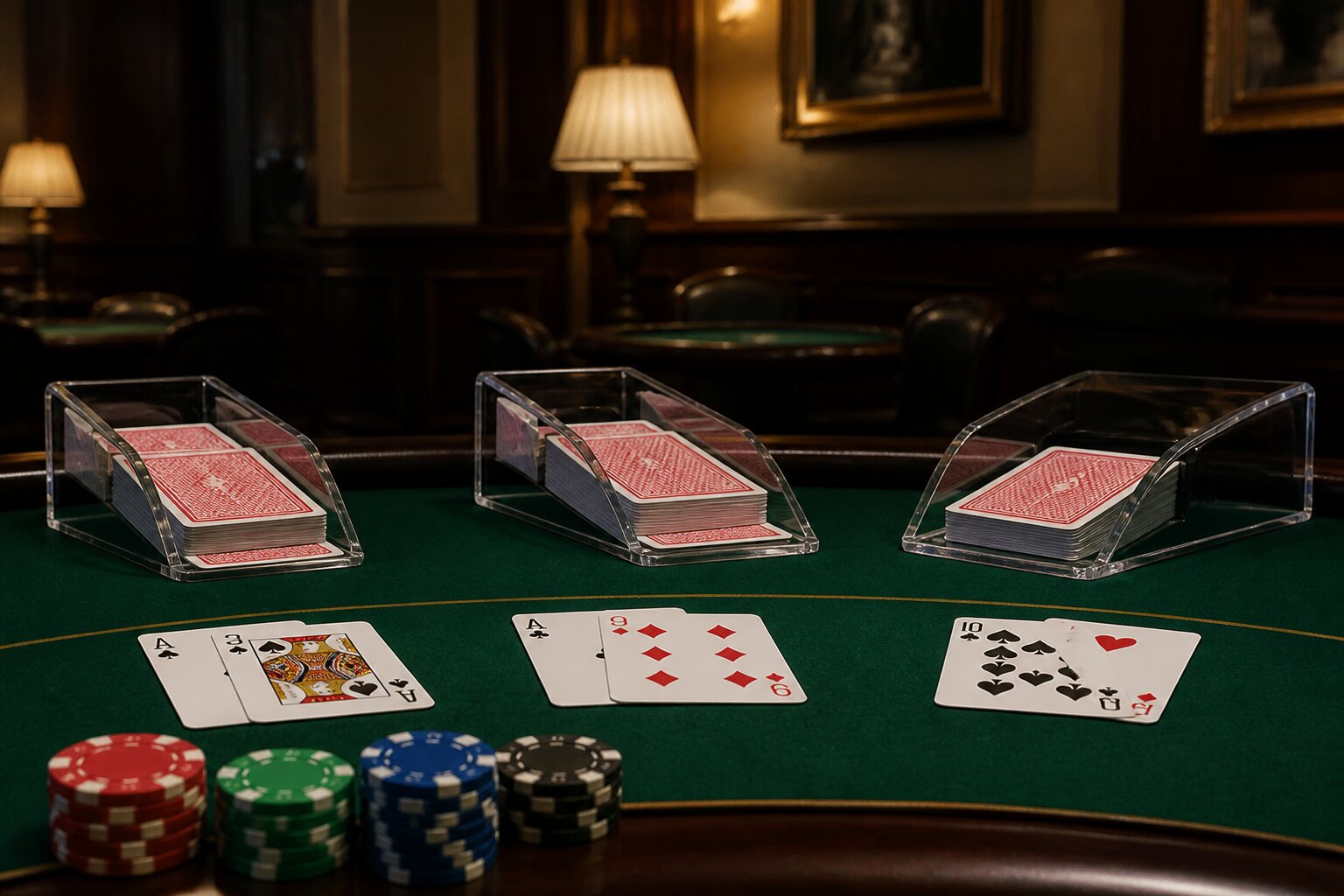
Ever noticed some blackjack tables use a single deck while others use up to eight? That choice quietly shifts the maths behind each hand and is worth a moment of attention whether you’re new to the game or have played for years.
Understanding how deck count changes probabilities can help you make clearer choices at the table and avoid common misconceptions about the game. Read on to see what really changes when more cards are shuffled into the shoe, and which facts are worth keeping in mind.
Understanding House Edge in Blackjack
The house edge is the built-in advantage the operator has over the player, expressed as a percentage. It represents the difference between the true odds of outcomes and the payouts offered; over many hands, that gap is what keeps the game profitable for the house. In blackjack, that edge is relatively small compared with many other casino games, and with optimal play it can be very low.
Knowing the house edge helps set realistic expectations: individual sessions can swing either way, but the long-term maths favour the operator by a small margin. Operators must publish the rules and payouts for each game, so players can see how those details affect the edge before they sit down.
How Do More Decks Change the Game?
Increasing the number of decks does not alter the basic rules of blackjack, but it subtly shifts the probabilities of drawing particular cards. With a larger pool of cards, the impact of any single card on the remaining composition is reduced, which affects the relative frequency of certain hands.
This matters in a few practical ways. For instance, the chance of being dealt a natural blackjack changes slightly as decks are added. The distribution of tens and aces through the shoe is different when many decks are involved, and that alters the likelihood of particular outcomes.
These are mathematical adjustments rather than changes in fairness. Operators design games so that outcomes are determined by the shuffled cards and the stated rules; deck count is simply one of the variables that influences the longer-term percentages behind the game.
Effects on Card Counting and Probability
Card counting relies on tracking which types of cards remain in the shoe to estimate how favourable the remaining deck is. When only one deck is used, every card played noticeably shifts these estimates. As deck count increases, each played card has a smaller effect on the overall composition, and keeping an accurate running estimate becomes harder.
That makes simple counting methods less effective in games with six or eight decks because the relative change caused by each card is diluted. In practical play this means techniques that might give an edge in single-deck games are far less influential when many decks are mixed together.
The mathematical takeaway is straightforward: deck count changes the signal-to-noise ratio in the shoe, which in turn affects how reliably a skilled player can infer the remaining card mix.
Why Do Casinos Use Multiple Decks?
There are several reasons operators favour multiple decks. Key reasons include:
- Reducing the frequency of shuffles, which keeps hands dealt more continuously and speeds up play.
- Making it harder for any player to gain an informational advantage about the remaining cards, including through card counting.
- Allowing dealers to deal more hands between shuffles, which improves table efficiency during busy periods.
Practical considerations play a part too. In a physical casino, a larger shoe means fewer interruptions to change or shuffle decks, which helps maintain a steady pace and reduces dealer fatigue. It also simplifies table management when there are long queues or peak time demand.
Online versions use virtual multi-deck shoes to replicate the same distribution of outcomes as live games. That keeps the feel and mathematics of the game consistent across platforms, so the same rules and expectations apply whether a game uses one deck or many.
Overall, multiple decks support consistent game flow, operational efficiency and a lower risk of information being revealed about future cards, all of which are important for fair and reliable play.
Common Myths About Deck Numbers and Fairness
Many beliefs about deck numbers are based on misunderstanding. Adding decks does not make a game rigged; it changes the underlying probabilities in measurable ways but does not alter the fairness of the random draw. Operators are required to be transparent about rules and payouts, so the number of decks and any special rules are normally visible before play begins.
Another misconception is that extra decks completely eliminate player opportunities. In reality, deck count makes only modest shifts to house edge and how certain strategies perform. The overall quality of a decision still depends on the specific rules in effect at the table, such as payout for a blackjack, whether the dealer hits on soft 17, and doubling or splitting options.
Single Deck vs Multi-Deck Blackjack: Key Differences
Single-deck games concentrate variance: each card dealt changes the shoe noticeably and patterns repeat sooner. This can make the game feel more transparent to an observant player and slightly alters the frequency of certain outcomes.
Multi-deck games dilute those effects. With six or eight decks, identical cards are spread across a larger pool, so the same card is less likely to recur quickly. This affects the distribution of tens and aces, subtly changing the odds of naturals and high-value hands. Rule variations are sometimes paired with deck count, so it’s important to check payouts and dealer rules; those differences often have as much impact on expected return as the number of decks itself.
Ultimately, the two formats offer different rhythms and statistical flavours. Choose the one that matches your preference for pace and the set of rules you find fair and understandable.
Making an Informed Choice at the Blackjack Table
Picking a table is about more than whether the shoe holds one deck or eight. It’s worth scanning the table rules and payout structure first, and matching those to your preferred pace and bet size. The number of decks is one factor among several—others, like whether the dealer hits on soft 17 or how blackjacks are paid, can move the expected return by similar amounts.
Keep your own limits clear before you play and focus on decisions that suit your bankroll and mood. If the session stops being enjoyable, take a break or walk away. Operators typically provide tools such as deposit limits and time reminders to help players manage their play. Using these tools can keep the experience positive and controlled.
Choosing wisely means balancing the math with what feels right for you at the table. With the rules understood and sensible limits in place, you can concentrate on playing the version of blackjack you enjoy most.
Final thought: the number of decks quietly alters the probabilities behind each hand, but understanding the rules and managing your play are the most effective ways to make sensible choices at any table.
**The information provided in this blog is intended for educational purposes and should not be construed as betting advice or a guarantee of success. Always gamble responsibly.