
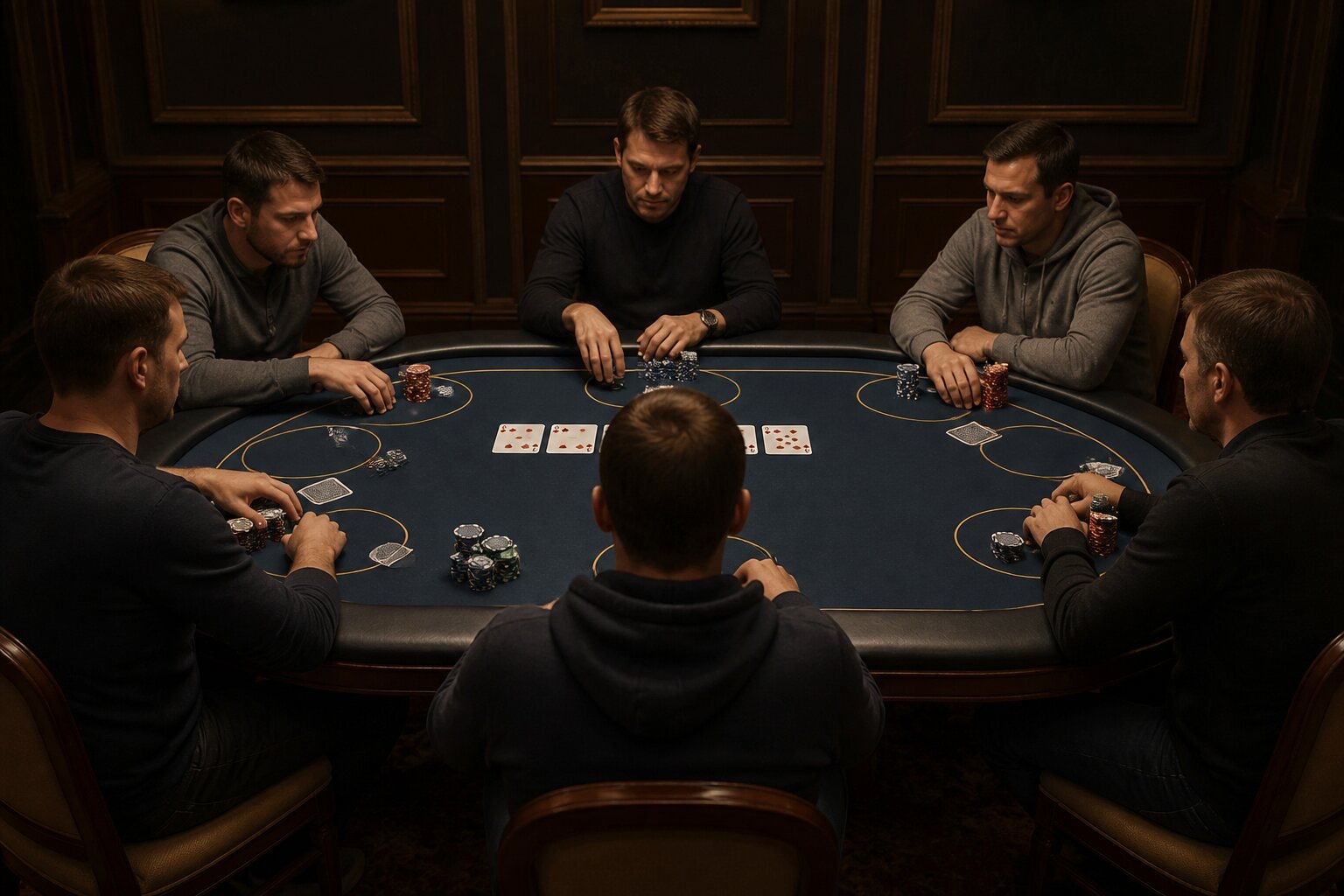
Ever wondered whether the chair you choose at a poker table changes how you should play? Many players underestimate how much position shapes decision-making. Understanding it will help you read situations better and choose hands more sensibly.
Whether you play with friends or at online tables, recognising which spots give you more information makes it easier to adjust your approach and avoid common pitfalls. Read on to see how each position affects the choices you face and how to use that to your advantage.
Why Is Poker Table Position Important?
Position determines the order in which players act during each betting round, and that order changes the quality of the information available when you make a decision. Players who act later can observe more of their opponents’ behaviour—who checks, who bets, who folds—and use that to shape their own response.
Acting early means committing before seeing others’ moves, which calls for a more cautious selection of hands and simpler betting choices. Acting late allows you to be more flexible: you can enter pots more often, apply pressure on opponents, or control the size of the pot when the situation calls for it. Position doesn’t make outcomes certain, but it meaningfully shifts the balance between risk and reward in a hand.
To see how this plays out, it helps to look at the specific seats around the table.
What Are the Different Poker Positions at the Table?
Poker seating is split into a few standard zones, each with its own strategic implications. These zones are commonly called early, middle and late positions, plus the blinds. Learning the characteristics of each will clarify why some hands are worth playing from one seat but not another.
Early Position
Early position covers the first seat to the left of the blinds—often called Under the Gun—and the next one or two seats. Players here must act before most of the table, so they often restrict themselves to premium hands like high pairs or strong broadway combinations. Facing potential raises and re-raises from later players makes post-flop play more demanding from these seats.
Middle Position
Middle-position players act after the earliest seats but before the late ones. This is a transitional zone where hand ranges can widen a little compared with early position, yet some caution is still necessary because players behind you may still be aggressive. Middle position is where you begin to mix in more speculative hands, such as suited connectors or medium pairs, depending on table dynamics.
Late Position
Late position includes the button (dealer) and the two seats immediately to its right. These seats provide the most information each betting round because they act last. The button in particular is powerful: acting last on every post-flop betting round allows you to control pot size, apply pressure with well-timed bets, and extract value when you have a strong holding. The two positions just before the button share many of these advantages, though slightly reduced.
Blinds
The small blind and big blind sit to the left of the dealer and are required to post forced bets before the deal. Because they already have money in the pot, these seats can be involved in a wide variety of situations, often facing raises from later positions. Post-flop, blind defenders frequently face positional disadvantages because they must act earlier than most opponents on subsequent streets.
Understanding these roles helps make sense of why the same hand can be played differently depending on where you’re seated.
How Does Your Seat Affect the Hands You Play?
Seat position directly influences hand selection and how you approach a hand after the flop. From early position, tight, straightforward ranges minimise difficult post-flop decisions. In practice this means folding marginal holdings that could put you in awkward spots against raises from later players.
In middle and late positions, you can broaden your range. For example, a hand like 7-6 suited is often worth entering the pot from late position because you can see how opponents react before committing more chips; from early position that same hand is more likely to be folded. Conversely, hands such as Ace-King or pocket Queens remain strong across most seats, but playing them from late position gives you extra tools to extract value or to fold if the action becomes hostile.
Post-flop play also shifts with position. Acting last lets you decide whether to inflate or defuse the pot based on how opponents act, while acting early forces you to choose lines that are less dependent on others’ behaviour. These subtleties are why experienced players pay close attention to seating and opponent tendencies rather than relying on fixed rules alone.
Does Table Position Influence Bluffing and Betting?
Position plays a central role in shaping betting strategy and the effectiveness of bluffs. When you act late, you have more context to judge whether a bluff might work: an opponent’s check or a pattern of folding can signal an opening to apply pressure. Being last to act also enables more precise bet sizing because you’re responding to concrete information rather than anticipating it.
From early positions, bluffing typically carries higher risk because you must commit before seeing how multiple opponents might react. That doesn’t mean bluffs are never appropriate early, but they require stronger reasoning and often target specific player types or known tendencies.
Ultimately, successful bluffing and betting are about reading the table and adapting to who’s in the hand. Position gives you a strategic edge in that reading, allowing you to choose when to be aggressive and when to prioritise pot control.
Are There Common Myths About Poker Table Position?
Several misconceptions tend to circulate among players learning the game. One is the idea that a particular seat will guarantee better results. No seat can assure consistent winnings; position alters decision quality but cannot eliminate uncertainty inherent in card play.
Another mistaken belief is that position alone makes complex strategies unnecessary. Some players assume that sitting on the button lets them dominate regardless of hand strength; in reality, opponents’ tendencies, stack sizes and table dynamics all interact with position to determine the right play.
Superstitions about “lucky” seats are common in casual games. It’s worth replacing those notions with practical habits: observe how your opponents act from their seats, note who overplays middle-range hands from early positions, and adapt your ranges accordingly. Thoughtful adjustment beats ritual every time.
What Is the Best Poker Seat for Beginners?
Beginners often benefit from choosing late seats when possible, as these allow more time to observe others and think through choices. Late positioning reduces the complexity of decisions because you regularly see opponents’ actions before committing chips, which helps with learning table dynamics and recognising betting patterns.
That said, rotating through positions can be instructive. Experiencing early- and middle-position play helps you learn which hands create trouble when information is limited. The most useful approach for a newcomer is to combine seat selection with disciplined bankroll control and gradual study: focus on hand selection, positional awareness, and reading opponents rather than chasing short-term results.
How Do Live and Online Poker Positions Differ?
The role of each seat remains the same in both live and online poker, but the playing environment changes how position affects you. In live games, physical presence, table talk and the slower pace give more time to assess opponents’ timing and body language. You also tend to remain at one table, so positional dynamics against the same players evolve slowly.
Online play accelerates the action and removes physical cues, so you rely more on betting patterns and timing tells captured by software. Fast pace and multi-tabling make position management more demanding: decisions happen quickly, and recognising which seats are favourable requires sharper focus. Despite these differences, the core advantage of acting later—more information—applies equally in both formats.
Key Takeaways on Poker Table Positions
Position is a strategic tool that changes how you select hands, control pots and apply pressure. Acting later generally offers better information and more options, while acting early calls for tighter, more straightforward play.
Remember that position interacts with many other factors: opponent tendencies, stack sizes and game format all influence the right choice in any spot. Practical experience—observing outcomes from different seats and adapting your ranges—builds the best intuition.
Finally, keep your play sustainable by managing your bankroll and taking breaks when you need them. With attention to position and steady practice, your decision-making at the table will improve over time.
**The information provided in this blog is intended for educational purposes and should not be construed as betting advice or a guarantee of success. Always gamble responsibly.