
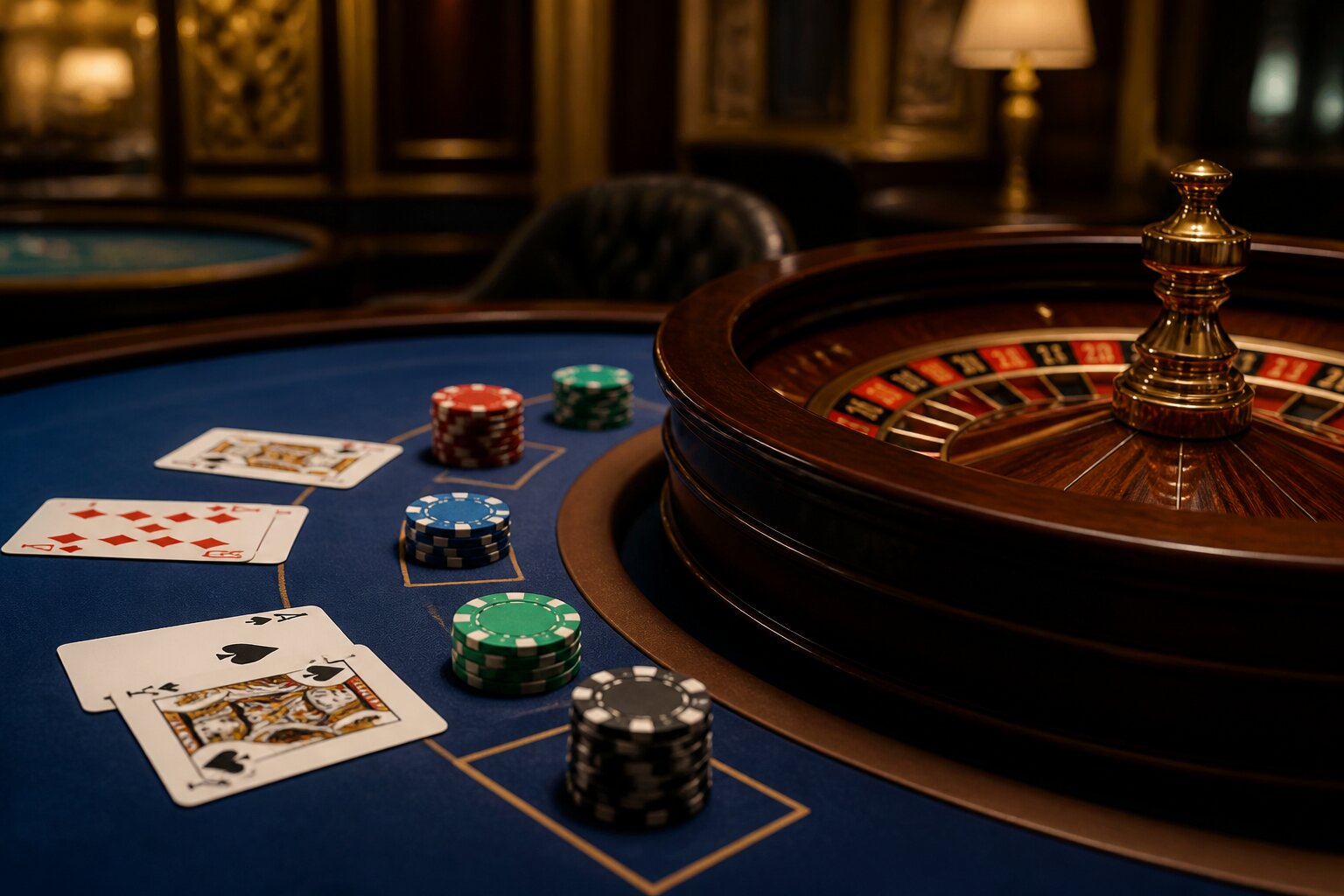
Choosing between blackjack and roulette can feel tricky when you want the best chance of keeping your stake. Both games have clear rules and different styles of betting, and understanding those differences helps you make a confident choice.
This article compares how each game works, how the odds and house edge stack up, and what you might expect from typical payouts. Read on for practical explanations and examples that make the maths clear without relying on myths.
What Are the Main Differences Between Blackjack and Roulette?
Blackjack and roulette offer very different experiences because of how decisions and outcomes are formed.
Blackjack is a card game played against a dealer. Each player receives cards, and the aim is to achieve a hand value close to 21 without going over. Players make choices that affect the outcome, such as whether to take another card, stand, or in some games split or double down. These decisions create an element of skill: learning basic strategy can reduce the casino’s advantage.
Roulette centres on a spinning wheel and a small ball. Players place bets on numbers, colours, or sections of the wheel, then await the result of a single spin. There are no decisions that influence the outcome once bets are placed, so the game is defined by fixed probabilities for each kind of wager.
Each round in both games is independent, but in blackjack the options available during play can influence your probability of winning a given hand, whereas in roulette your choices only determine which fixed odds you are exposed to.
Before we look at numbers, it helps to understand how those fixed odds and player choices translate into real probabilities.
How Do the Odds Differ in Blackjack and Roulette?
The way odds are calculated differs because blackjack involves player decisions and card composition, while roulette relies on the wheel’s layout.
In blackjack, the chance of winning a hand depends on factors such as how many decks are in use, the specific house rules, and how closely you follow basic strategy. With favourable rules and good play, a player’s chance of winning a hand typically sits in the low-to-mid 40s percentage-wise, with pushes occurring in roughly 8–10% of hands. The remaining outcomes are dealer wins. Card composition matters too: when more high-value cards remain in the deck, the probability of certain profitable situations, like getting a blackjack, shifts slightly.
Roulette odds are straightforward and tied to the wheel type and bet type. In European roulette, which has a single zero, a bet on a single number has a 1 in 37 chance, about 2.70%. In American roulette, which has an extra double zero, that single-number chance becomes 1 in 38, about 2.63%. Even-money bets, such as red or black in European roulette, offer a probability close to 48.6% per spin because the zero slots remove the exact 50/50 split.
Both games present independent outcomes from one round to the next. With blackjack, your choices alter how likely you are to win a particular hand; with roulette, your choice is which fixed probability you accept when placing a bet.
Understanding House Edge: Which Game Favours the Casino More?
The house edge is the expected long-term advantage the casino holds over each bet, expressed as a percentage. It shows the average portion of each stake the casino will retain over time.
Blackjack can offer one of the lowest house edges in the casino when played with basic strategy and favourable rules. Typical values range from around 0.5% to 2%. That means mathematically the average loss per £100 wagered would be about 50p to £2. Rule variations such as dealer hitting on soft 17, the number of decks, and payout on blackjack affect this figure.
Roulette’s house edge is fixed by the wheel’s design. European roulette with a single zero yields about a 2.7% house edge on most bets. American roulette, with both a zero and double zero, increases the house edge to roughly 5.26%. This difference is why many players favour European wheels when both are available, as the lower edge makes losses slower on average.
House edge applies across many bets and many rounds; it does not predict any single result. Knowing these percentages helps set realistic expectations about long-term outcomes and how different game choices influence the likely rate of loss.
How Do Payouts Compare in Blackjack and Roulette?
Payouts describe how much you receive if your bet wins, and they vary both between these games and within each game’s range of bets. Understanding common payouts makes it easier to compare potential returns.
Typical Blackjack Payouts Explained
A natural blackjack—an Ace plus a 10-value card on the initial deal—traditionally pays 3:2. That means a £10 bet returns £25 in total: £15 profit plus your £10 stake. Regular winning hands pay even money, or 1:1, so a successful £10 hand returns £20 total.
Some games offer different blackjack payouts, such as 6:5, which lowers the effective return and increases the player’s long-term cost. Other rule differences, like late surrender or whether the dealer checks for blackjack, also change the expected value of each decision. Because payouts and rules vary, it is sensible to check them before you play to know how they affect the house edge.
Common Roulette Payouts and Bet Types
Roulette offers a clear ladder of payouts that correspond to how many numbers your bet covers. A straight-up bet on a single number pays 35:1, so a £1 bet would return £36 total: £35 profit plus your stake. Bets that cover two numbers pay 17:1; dozens and columns pay 2:1; and even-money bets such as red/black return 1:1.
The trade-off is simple: covering more numbers reduces the payout but increases the chance of a win on that spin. These fixed payouts make roulette easy to understand, but the house edge remains the deciding factor over many spins.
Are There Common Myths About Odds and Payouts in Blackjack and Roulette?
Misunderstandings about how odds work can lead to poor choices. Clearing these up helps you see which arguments hold water and which do not.
A frequent myth is that past results influence future ones—suggesting a wheel or dealer is “due” to produce a particular outcome. In both blackjack and roulette each round is independent of the last. In blackjack, card counting is a technical technique that tracks card composition and can shift perceived advantage in short stretches; it is not the same as believing outcomes are due, and it requires careful knowledge of the rules and environment.
Another misconception concerns betting systems, such as progressive doubling strategies. These approaches do not change the underlying probabilities or the house edge; they alter the variance and exposure per bet, often increasing the risk of a large loss if a streak of losses occurs.
Separating fact from fancy makes it easier to decide what to expect from either game and to choose a style of play that matches your goals.
Which Game Is Better for Players Based on Math?
Viewed purely mathematically, blackjack typically offers the more favourable long-term expectation for a player who uses sound strategy and plays games with good rules. The lower house edge means the average loss per unit wagered is smaller than it is for most roulette bets.
Roulette provides a clear and varied set of bet choices with fixed payouts, which some players prefer for its simplicity and pacing. The American wheel’s higher house edge makes it a less efficient choice from a mathematical standpoint, while the European wheel is closer to blackjack in terms of relative cost over time, though still generally worse than optimal blackjack play.
Whichever game you choose, approach it with a clear understanding of the maths and an awareness of how rules and payouts affect long-term results. Keep play within limits you set for yourself and treat gambling as entertainment rather than a method of making money. That way you can focus on the experience and the strategy without losing sight of what matters most.
Final thought: knowing the numbers helps you pick the game that suits your style, so use the comparisons here to play in a way that fits your priorities and keeps the experience enjoyable.
**The information provided in this blog is intended for educational purposes and should not be construed as betting advice or a guarantee of success. Always gamble responsibly.